An injured knee and a hard turn in the weather changed our Cathedral Lakes backpacking trip. What remained was a quieter kind of Yosemite adventure—and a reminder that sometimes the mountains get to decide what the trip becomes.
Packing for this trip felt unsettled from the beginning. I was driving from Mount Vernon, Washington, to Carson City, Nevada, before heading into Yosemite with my son Brandon and my friend Tom. It was a long way to travel for a backpacking trip, and even though Yosemite was familiar territory, there were more unknowns than I was used to carrying.
Maybe that was why I overpacked. I had room in the vehicle, and I knew I would be staying afterward for another trip through Northern California. Whatever the reason, I looked too much and never quite found the comfortable rhythm that usually comes before heading into the mountains.
Then car trouble nearly derailed far more than the backpacking trip. A huge repair expense could have changed several plans in my life, but somehow I was able to get back on the road and reach Carson City in time.
Returning to Yosemite After a Year Away
I had spent nine months in Washington getting to know new landscapes, but backpacking had taken a back seat to day trips and exploration. If I’m honest, I missed more than time on the trail. I missed that connection to Sierra weather, the feel of its wilderness and the quiet confidence that comes from spending a summer in a place.
I had logged zero hours on Sierra trails so far in 2026. That changed how I approached this trip more than I expected.
Brandon had been smarter about the journey. He flew into Reno the night before and had to keep his gear to a backpack and a travel bag. I had arrived by car with room to keep adding things. By 7 a.m. Thursday, though, we were both packed and pulling onto Highway 395. We picked up Tom and headed south toward what I consider the most alluring entrance to Yosemite—and one of the finest drives in the Eastern Sierra.
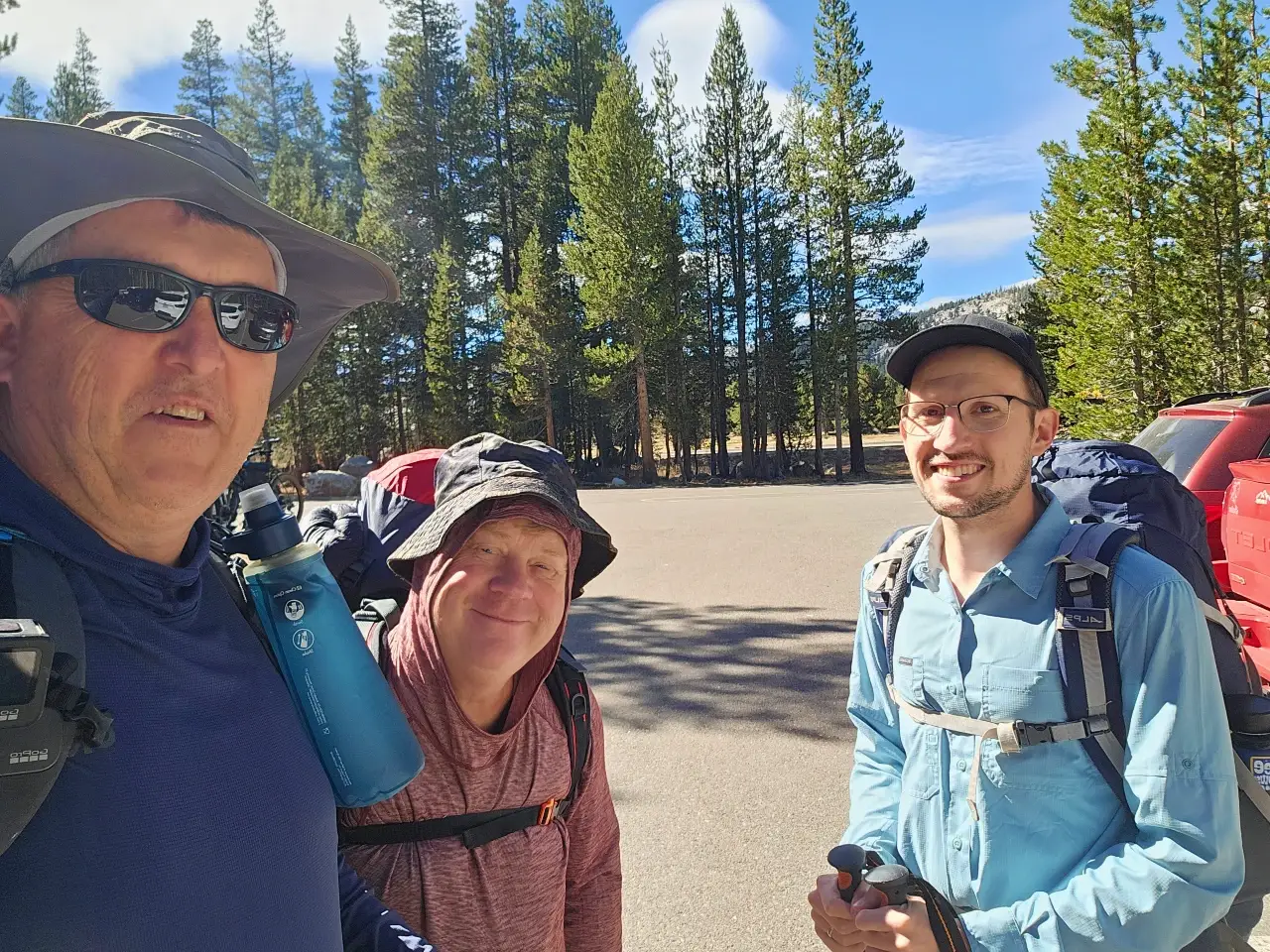
We have made this trip so many times that its rhythm feels familiar: the road south, the long views and the conversations that come easily when there are miles ahead. We caught up on life, talked about careers and enjoyed being together. After a quick stop at the Whoa Nellie Deli in Lee Vining, we arrived at Yosemite’s east entrance almost exactly on schedule.
It felt as if I had been there yesterday.
In reality, it had been more than a year—the longest stretch without Yosemite in the past 14 years of my life. Yet Tuolumne Meadows still looked familiar, and the trees along Tioga Road offered a calm steadiness as we headed toward the wilderness permit station.
A 27-Degree Forecast Changes the Equation
I was home, in a sense.
Yosemite has quietly become that for me in my wilderness life. I know this region of the park well enough that much of the normal stress disappears when I arrive. I know the trails, the landmarks and the places where old memories wait. After so much time away, I was relieved to find that the feeling had survived the distance.
At the permit station, the rangers were friendly but appropriately stern as they talked about protecting the Cathedral Lakes basin. Good on them. I like it when rangers care enough to make the responsibility clear. Maybe I did not need the entire reminder.
Then again, who am I to decide that? Of course I needed it.
The first real clue that our weekend might be different than expected was on the weather board. It showed a low of 27 degrees.
I asked whether that was accurate because the last forecast I had seen predicted something closer to 37.
Ten degrees mattered when we were packing for nights at elevation. Twenty-seven would test some of our gear, and I looked at our group wondering whether we had brought the right layers.
We pulled into the new Cathedral Lakes trailhead parking area near the visitor center and found one of the last available spaces—and it was only Thursday. After changing clothes, making one final bathroom stop and adjusting our packs, we were on the trail by 10:15 a.m.
We had roughly five miles and 1,100 feet of climbing ahead of us.
Cathedral Lakes Backpacking: At a Glance
Start: Tuolumne Meadows Visitor Center. The current access adds roughly 0.7 mile each way compared with the old trailhead.
Distance: About 4.1 miles one way to Lower Cathedral Lake. Upper Cathedral Lake adds about 0.7 mile, for roughly 4.8 miles one way before walking to camp.
Overnight: A Yosemite wilderness permit for the Cathedral Lakes entry trailhead is required. Day hikers do not need a wilderness permit.
At camp: Choose an established, durable site at least 100 feet from water and trails; use approved bear-resistant food storage. Campfires are prohibited in both lake basins.
Hiking the Cathedral Lakes Trail
The temperature was almost perfect for hiking. As we walked that first stretch alongside the highway, I felt the tension I had carried from Washington begin to fall away. I had walked this way before. Yosemite had given me so many good weekends, including a summer only a year earlier when I covered a full 100 miles in its backcountry. I remembered old meadows, evenings listening to coyotes and climbs that took our breath away before leaving us grateful for where they led.
We turned uphill, and the trail began asking for some effort.
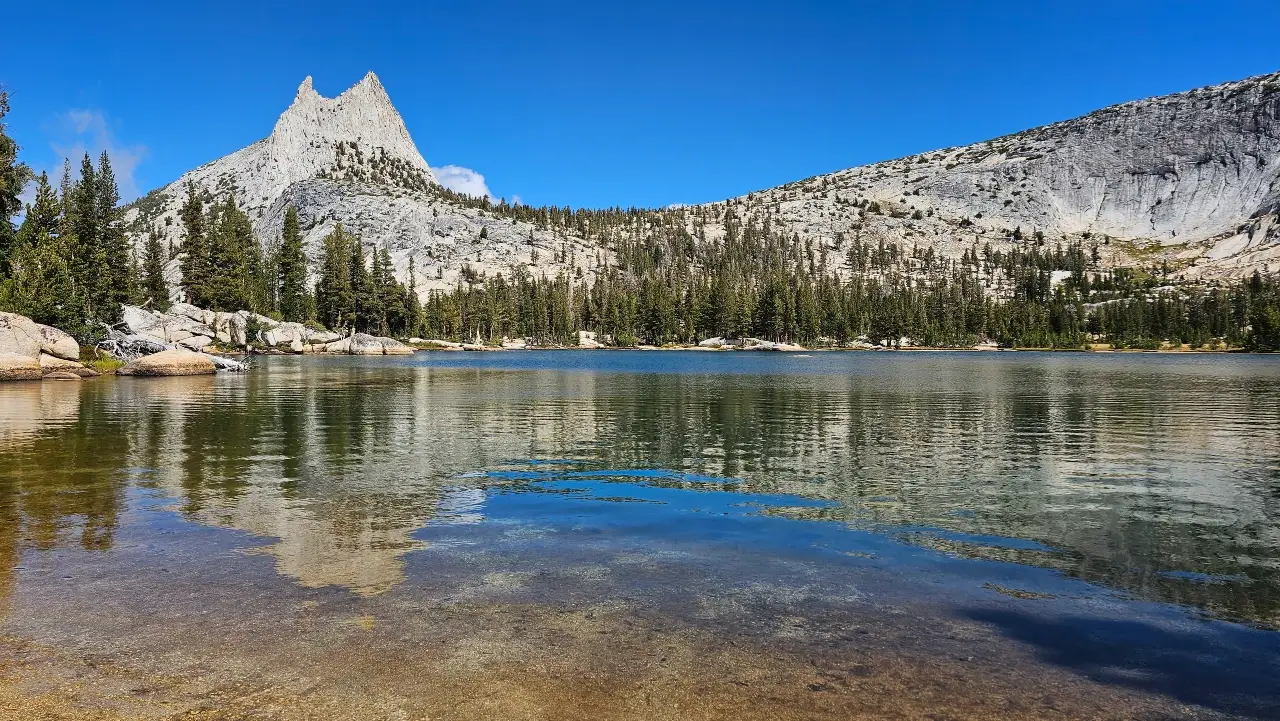
Cathedral Lakes was my first Yosemite trail. I still remember that initial climb kicking my butt 14 years ago, and I was not even carrying a full backpack then. This time I was fully loaded after nine months of living near sea level. I moved slowly, but honestly, I felt good. Perhaps the extra breaks while waiting for Tom helped.
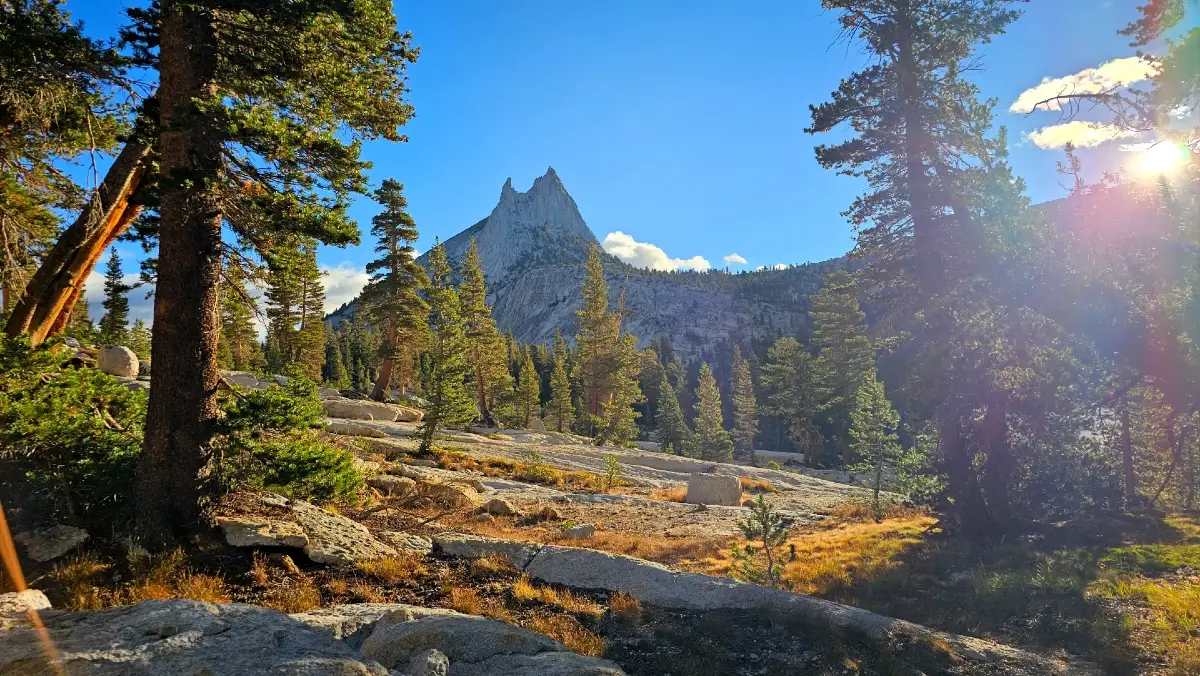
After the first climb, the trail reaches a bench where the land levels and wanders through what I think is one of its prettiest sections. A large granite wall rises along the edge, marked by rockfall. Meadows compete with pines for space. Older trees create pockets of deep shade, and a small, spring-fed creek crosses the trail.
Just beyond that creek, the route begins climbing again.
Fourteen years later, I was returning with my son and my friend, this time to stay rather than make a quick visit. We planned to spend one or two nights at Cathedral, then move farther into the backcountry for another night or two. I wanted to share familiar places with them and experience those places differently myself.
There was no need to pile on mileage.
By the time we started climbing that section, I had found my trail legs and was doing better than expected. The only concern was the chill beginning to ride the wind as we reached the upper bench and approached the junction for Lower Cathedral Lake.
We passed the turn. Our plan was to possibly camp at Lower Cathedral on our final night, giving us a shorter exit the following morning. For the next mile, anticipation grew. I told Brandon and Tom about the herd of deer I had once encountered in the meadow below Upper Cathedral Lake and described the route I hoped to take to find a campsite.
As we approached an old creek bed, Brandon moved ahead to look for a place to camp. Tom and I meandered through the trees until we could faintly see the lake beyond them.
We had nearly made it.
I stepped onto a boulder.
Pop.
A Hundred Yards Short of Upper Cathedral Lake
The pain was immediate. My right foot caught me, and my trekking poles took some of the weight as I lifted my left foot off the ground. For a moment I stood there trying to understand what had happened.
I could see the lake through the trees.
We were barely a hundred yards away.
I put the foot down again. The knee held my weight, which was a relief, but it felt weak and wrong. Tom and I made our way to the shore, where I dropped my pack and sat down. Brandon was already ahead of us looking for camp. I watched for him through the trees while the knee throbbed and tried to decide how much of our trip had just changed.
Brandon found a small cluster of trees on the northwest side of the lake, roughly 300 feet back from the shore and above the usual lakeside camps. I hobbled up to join him. He could see something was wrong before I said much. I told him the injury was real, and that we might have to rethink the days ahead.
We unpacked and put up the hammocks and tent. I could still move around camp, but every step carried a question: Would this settle down overnight? Could I walk farther tomorrow?
I had come to Cathedral hoping to share the places beyond the lake with Brandon and Tom.
Now I was measuring the distance between camp and the water.
Then the wind began to make itself impossible to ignore. It came hard down the rock face behind us, cold and constant, finding the gaps in our layers as soon as we stopped moving. The ranger’s forecast of 27 degrees no longer felt like an abstract number on a board.
We collected water, pulled on what warm clothing we had and started thinking about the night ahead.
We had reached the lake.
For now, that was enough.

A Cold First Night at Cathedral Lakes
By dinner we were wearing gloves and stocking hats, huddled around the burners to shield the flames and borrow a little warmth. Brandon and Tom had no puffy jackets; I had forgotten one of my layers. The forecast had warned us, but the wind gave the number its meaning.
Boiling water reminded us to make something hot to drink. I had packed freeze-dried meals, while Brandon had chosen instant mashed potatoes. They sound dull at home, but at a cold camp a simple, warm bowl can beat almost anything. Brandon won dinner that night.
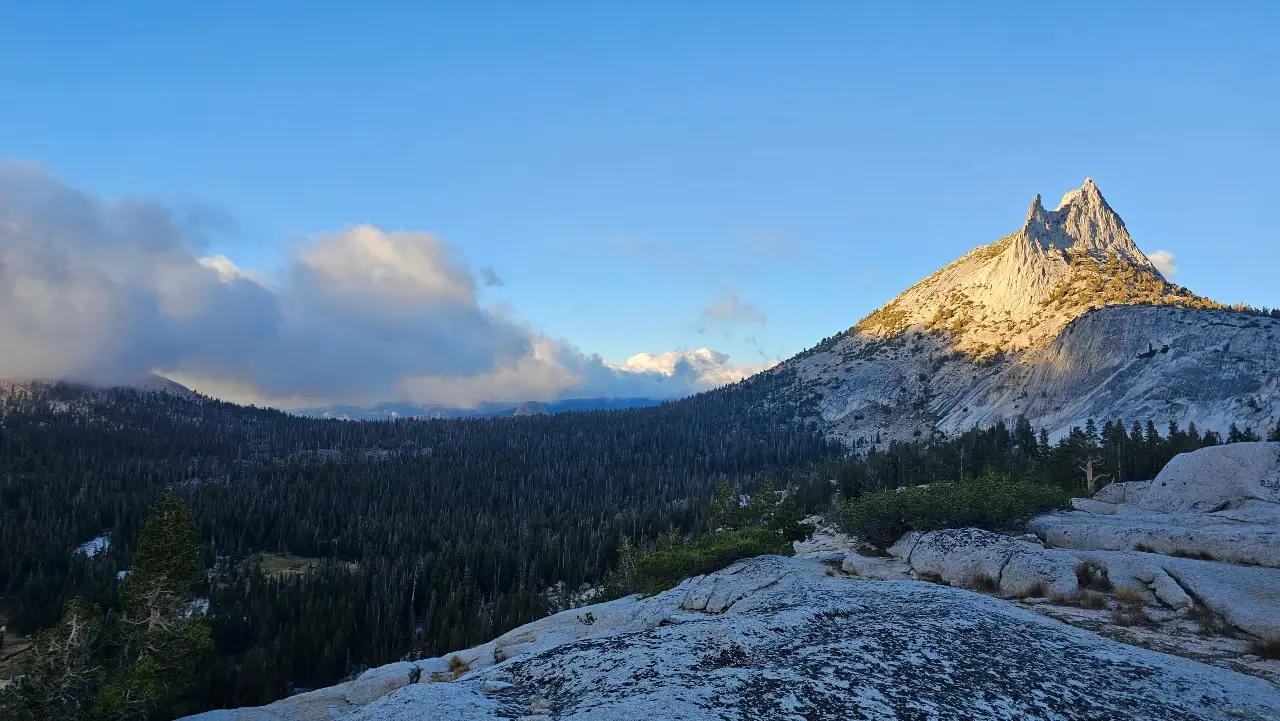
Across the lake, clouds swept toward Cathedral Peak and broke against the granite. I watched the light move over its weathered faces while the water shivered below. Even with my knee aching and our plans uncertain, I was glad we were there together.
By seven we were climbing into our bags. Brandon’s 20-degree sleeping bag would be tested in his tent. Tom and I had warmer sleep systems, but our hammocks were exposed to the wind. The tarps slapped and snapped for hours.
I found a warm pocket inside my quilt and underquilt and, to my surprise, slept well. Tom stayed warm but was awake much of the night with the noise. Brandon was cold and barely slept. His pad and tent helped, but the night was harder on him than on either of us.
In the morning I waited until about seven to get up and make coffee. The air felt a little kinder than it had at dinner. My knee did not hurt much at rest, but once I began moving around camp, its weakness was clear.
The longer trip we had imagined was already slipping away.
When a Backpacking Trip Becomes a Day to Stay
After breakfast, Brandon set out alone toward Sunrise High Sierra Camp, with Clouds Rest as a possibility if the day went well. He had spent enough time in Yosemite to feel at home on its trails. I wanted him to have the long walk I could no longer make.
I collected water and tested my knee around camp. It could carry me, but it did not feel dependable. The exploring I had pictured for the three of us was over for me. I would stay near Cathedral, let it rest and see whether I could manage a short walk later.
Tom stayed with me. We have shared six or seven summer backpacking adventures, and he is an easy companion in the backcountry. He does not crave miles the way I often do. On other trips he has wondered why we could not sit a little longer in a place we had worked so hard to reach.
This time we did.
We warmed ourselves in the sun, wandered over the granite ridge above camp and talked without trying to get anywhere. The shoulder-to-shoulder hours have always been part of why I value traveling with him. Today there was room to give them our full attention.
Eventually we walked down to the lake and went in for a swim. The cold water woke me up, and for a while the knee was only one detail of the day. We stayed by the shore afterward, watching the light shift across the basin.
I had been expecting a route.
Cathedral offered us a place to be.
Cathedral Pass and the Meadow Beyond
By afternoon I was restless enough to try a little farther. We decided to walk around the lake toward Cathedral Pass, with the understanding that I would turn back when the knee asked me to.
Tom and I went around the lake and up to Cathedral Pass, then followed the meadow for another half mile toward Echo Lakes. Brandon and I knew that country from earlier trips. I had hoped we might spend a night there this time, but standing in the meadow was as close as I would get.
We startled a few deer, including two spotted fawns. I wondered how much growing they still had to do before the Sierra’s short summer gave way to colder days. The wind had already made the season feel farther along than the calendar suggested.
The meadow was beautiful enough to make me want to keep walking.
My knee gave a clearer answer.
Echo Lakes and the return to camp would ask too much of it. I told Tom we should head back, and we turned toward the pass.
We rejoined the John Muir Trail, crossed back into the Cathedral basin and then took a familiar route off trail behind the lake to our camp. The smaller walk had given me a little of what I came for. It had also confirmed the limit I was trying to ignore:
There would be no longer backpacking loop this weekend.
Finding Our Way Back
Tom and I reached camp in the late afternoon.
Around four, I began looking for Brandon. I wondered whether he had reached Clouds Rest, how far he had gone and when he might come back. At about five he walked in, tired, with a longer story than the day we had planned for him.
He had made it to Sunrise High Sierra Camp, but followed the wrong trail out and ended up farther down the John Muir Trail. Instead of turning around, he left the trail to try to reach what he thought was the junction near Lower Sunrise Lake and Clouds Rest. The correction cost him two extra ridge climbs before he found Lower Sunrise Lake and returned to us on the trail.
Retracing his steps would have been simpler. I could hear the familiar price of overconfidence in his account; anyone who has traveled enough miles has a version of that lesson.
I was relieved to have him back and glad he could tell the story himself.
As we made dinner, the wind returned and low clouds raced across the sky toward Cathedral Peak. We talked about the next day. I could not carry a pack farther into the backcountry, and Brandon had a flight home on a tight schedule. A slow exit on my knee would leave too little room for surprises.
So I asked whether we should hike out in the morning, sleep in warm beds that night and give Brandon an easier trip to the airport.
We all agreed.
Cathedral was beautiful, but we had already been given enough to work through.
One More Night Beneath Cathedral Peak
We went to bed prepared for another night of wind. Brandon borrowed a fresh pair of wool socks, hoping for a little more warmth.
Soon after we settled in, the gusts stopped.
The quiet was so complete that I found myself listening for the tarps to snap again.
I had slept through much of the noisy night before. This time the stillness kept me awake. Around three I got out for a bathroom break and stayed outside for 20 minutes, looking at the stars.
I have never figured out how to photograph a sky like that.
I could only stand there and take it in.
By morning, Brandon said the socks had helped. We drank coffee, ate breakfast and let the camp wake slowly. There was no need to hurry into the cold. We knew we were leaving, and I wanted a little more time with the basin before putting weight on my knee again.
The first night had taught us what the forecast alone could not: three people can sleep in the same weather and have three very different nights.
What a 10-Degree Forecast Change Means for Your Sleep System
Read the whole rating. The number on a sleeping bag or quilt is not a promise that you will feel comfortable at that temperature. Check the maker’s comfort guidance and leave room for the way you personally sleep.
Insulation below matters. A pad separates a ground sleeper from cold earth. In a hammock, an underquilt protects the underside that your body compresses.
Our camp was the test. Brandon had a 20-degree bag and an R-5 pad, yet he was cold the first night. Tom and I carried warmer sleep systems; my zero-degree top quilt and new zero-degree underquilt made a real difference in the wind.
Pack for your own comfort. Dry base layers, warm socks, a hat and a puffy layer can help, but each person’s cold tolerance is different.
Hiking Out of Cathedral Lakes
We started packing around ten. After two nights at Cathedral, I had no ceremonial goodbye in me.
God willing, I will come back.
The basin sits too close to the heart of the Cathedral Range, and to so many places I love, to feel like a place I have finished with.
I could walk normally on level ground, but once the pack was on, my knee let me know it was still injured. Downhill was worse. We returned to the John Muir Trail and took the descent slowly, my trekking poles doing more work than they had on the way in.
The hike out took roughly an hour longer than usual.
Leaving early had been the right call.
I usually dream about a swim after coming off the trail. The cold wind had returned, so there would be none this time. We made a quick rinse at Tioga Lake and headed down the pass.
In Lee Vining we stopped for our annual Mono Cone burgers. Farther north came the luxury of shakes at Walker Burger. The familiar stops made the drive feel almost ordinary again: Tom and Brandon in the car, the miles passing, our trip becoming a story we could tell from a warm seat.
The uneasiness I had felt while packing in Washington had followed me through the car trouble, the cold and the pop in my knee.
Yet I will cherish this weekend.
I had expected an easy return to a place I know well. Instead, the smallest backpacking trip I planned for the summer became one of the harder ones to navigate.
Cathedral did not give us the route we came for.
It gave us time together, a meadow worth reaching, stars I could not photograph and a reason to listen when the mountains changed our plans.
We went home carrying all of it.