There are people who go outside to see something, and there are people who seem to spend their lives learning how to notice what is already there.
For photographer and author Larry Laverty, that education started remarkably early—with birds, butterflies and an oak tree outside his childhood home. It continued in the mountains, including an experience at Yosemite Mountaineering School that gave a young Laverty a new sense of freedom and confidence in wild places.
Over the decades, the subjects changed. Mountains gave way to people, elephants, buffalo and other wildlife. Photography became writing. Observation increasingly became conservation.
But the thread running through Laverty’s story remained remarkably consistent: pay attention long enough, and the natural world begins to reveal stories most of us walk right past.
Our Guest: Larry Lafferty
Larry Laverty is a writer, wildlife photographer, conservationist and longtime outdoor adventurer whose work explores our relationship with the animals and wild places around us.
Before turning his attention more fully to wildlife photography and conservation, Larry spent 30 years as a professional actor, appearing in more than 100 film and television productions. But the outdoors and photography have been constants throughout his life. He received his first camera at age five and grew up climbing, skiing, cycling and backpacking, including formative experiences at Yosemite Mountaineering School.
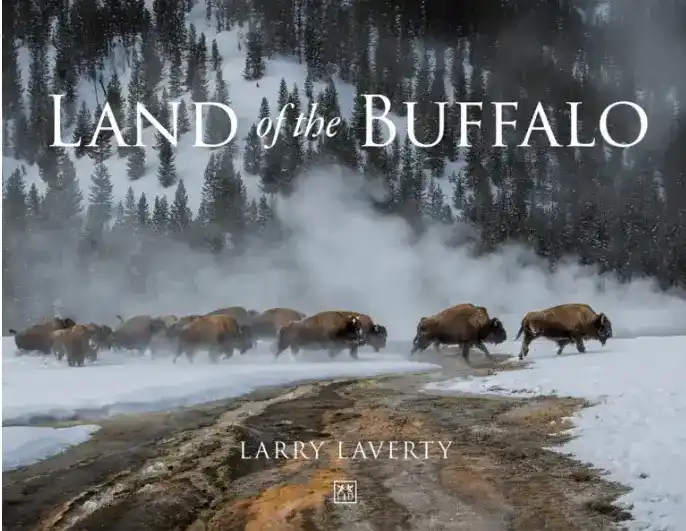
Today, Larry combines photography and writing to tell the stories of wildlife around the world. His first book, Power and Majesty: The Plight and Preservation of the African Elephant, documented the lives and conservation challenges of Africa’s elephants. He followed it with Magnetic: Humanity and the Asian Elephant and, most recently, Land of the Buffalo, a photographic and written exploration of the buffalo of Yellowstone National Park.
Across all of his work, Larry’s goal is remarkably consistent: encourage people to look more closely at wildlife, understand the lives of the animals we share the planet with, and ultimately care about what happens to them.
Learning to Look
Laverty’s connection with the natural world reaches back almost as far as he can remember.
He recalls being fascinated by butterflies and birds outside his childhood home before he could even walk. By four years old, an oak tree visible from his crib had become part of his world, and exploring outside with his father helped turn simple childhood curiosity into something more enduring.
Photography arrived almost as early.
Laverty received his first camera when he was five. His father had photographed during his wartime service, giving Larry an early example of photography as more than simply taking pictures. A camera could preserve a moment, document an experience and eventually tell a story.
That idea would follow him for the rest of his life.
Yosemite Changed the View
One of the most important chapters in Laverty’s outdoor education came as a teenager at Yosemite Mountaineering School.
For anyone who has stood beneath Yosemite’s granite walls, the idea of climbing them can seem equal parts irresistible and intimidating. For a young Laverty, getting onto the rock became something else: freeing.
The experience helped build confidence not only as a climber, but in the way he moved through and understood wild landscapes.
Years later, that comfort in steep and exposed terrain would influence his photography. Going where the story required him to go—or looking at a landscape from an angle others might avoid—became part of the way he worked.
It is one of the fascinating connections in Laverty’s story. An adventure experienced years earlier can quietly change the way we see everything that comes afterward.
The Influence of Adventurous Experiences
Larry’s teenage years were marked by a transformative experience at Yosemite Mountaineering School. He vividly described a climb that left a lasting impression:
“It was just a freeing experience.”
This adventure not only built his confidence in the outdoors but also influenced his approach to photography. Navigating the vertical landscapes of the mountains made him fearless with his camera, allowing him to capture the natural world in ways many might not consider.
When Photography Became More Than a Photograph
Laverty’s path as a photographer did not move directly from Yosemite to wildlife.
For a time, he photographed people and worked in street photography, learning to watch body language, anticipate moments and connect with a subject rather than simply point a camera toward it.
Those skills translated surprisingly well when wildlife became a larger part of his work.
Animals do not pose on command. The photographer has to observe. Wait. Notice behavior. Learn patterns. Understand when to move and, perhaps more importantly, when not to.
That patience eventually became central to Laverty’s photography.
The camera was no longer simply a way to record what he encountered. It became a reason to look more carefully.
From Observation to Conservation
Eventually, looking more carefully also made it harder to ignore what was happening to some of the animals Laverty photographed.
His involvement with the Global March for Elephants became an important turning point. Wildlife photography could celebrate an animal’s beauty, but it could also help people understand what those animals were facing.
Photography had acquired another purpose.
Writing followed a similar path.
After initially helping his father by ghostwriting a column, Laverty began developing his own voice. Words gave him something photography alone could not: another way to provide context, explain what he had witnessed and invite readers into the lives of the animals he had spent so much time observing.
Photography could make someone stop.
Writing could help explain why they should care.
Together, they became Laverty’s way of sharing the wild.
Seven Years Among the Buffalo
That combination of patience, photography and storytelling is particularly evident in Laverty’s newest book, Land of the Buffalo.
The book is built around years spent observing and photographing the buffalo of Yellowstone National Park and features approximately 150 photographs.
But the significance of that kind of project is not simply the number of photographs collected.
Spend a few minutes watching a buffalo and you may come away with an impressive photograph.
Spend years watching them and something different begins to happen.
Individual encounters become patterns. Behavior becomes recognizable. Seasons change. Relationships between animals, landscape and people become more apparent. The photographer stops simply searching for a picture and begins documenting a much larger story.
That distinction runs throughout our conversation with Laverty.
Wildlife is easy to admire from a distance. Understanding it requires time.
Why We Tell Stories About Wild Places
Laverty’s work has taken him far beyond the Sierra—from elephants to Yellowstone’s buffalo—but his story keeps circling back to an idea that feels very familiar to anyone who spends time exploring the Sierra Nevada.
The more closely we look at a place, the more there is to see.
A mountain can be scenery until someone teaches us its geology.
A trail can simply be a route until we understand who traveled it before us.
An animal beside the road can become part of the landscape until we stop long enough to watch what it is actually doing.
That is part of the reason photographers, writers, artists and storytellers matter to our experience outdoors. They can point toward something we have seen dozens of times and somehow allow us to see it again.
Larry Laverty has spent much of his life doing exactly that.
His journey began with a child watching birds and butterflies outside his home. It carried him onto the granite walls of Yosemite, into street photography, toward elephants and conservation, and eventually through years of observing buffalo in Yellowstone.
Different places. Different subjects. Different stories.
The practice has remained much the same:
Look longer. Pay attention. And never assume you have already seen everything there is to see.
Writing to Share Stories
Larry’s writing journey was also significantly influenced by his father. After ghostwriting a column for him, Larry found his voice, using it alongside his photography to share stories about wildlife and nature.
“I wanted to use writing to share as much as I can with people to increase their appreciation for these animals.”
Reflection
Larry Laverty’s journey illustrates the profound impact of early experiences in nature and the power of storytelling through both photography and writing. His work invites us to see the world differently, reminding us of the beauty and importance of the natural world.
Explore more of Larry’s insights and experiences in the full episode, where he continues to share his love for wildlife and the stories that connect us all.
Watch the Full Conversation
Join Sierra Rec Magazine publisher Charlie Pankey for the complete conversation with Larry Laverty as they explore Yosemite, climbing, photography, wildlife, conservation, storytelling and the experiences that taught Larry to see the natural world differently.
Seeing the Sierra is a Sierra Rec Now series exploring the writers, photographers, artists, scientists and storytellers whose work changes the way we experience wild places.