Diamond Peak celebrates 60 years, Sierra-at-Tahoe marks its 80th anniversary, and Mammoth Mountain’s Unbound Terrain Parks turn 30. Three very different stories from the Sierra’s winter history.
Every winter, the Sierra ski industry gives us something new to talk about. New lifts, new terrain, new technology, and plenty of reasons to get excited about another season on the slopes.
But this winter, three Sierra ski destinations are celebrating something a little different.
Diamond Peak in Incline Village turns 60. Sierra-at-Tahoe, along the Highway 50 corridor, celebrates 80 years. And down in the Eastern Sierra, Mammoth Mountain’s Unbound Terrain Parks mark three decades of helping change the way people ski and snowboard.
Three milestones. Three very different mountain stories.

One is about a community-owned ski resort that has managed to hold onto its identity. Another is about a mountain recovering from one of the most destructive wildfires in Sierra history. The third celebrates a terrain park program that helped push freestyle skiing and snowboarding into the mainstream.
Together, they offer a pretty good reason to look back before we head into another Sierra winter.

Diamond Peak Celebrates 60 Years Above Lake Tahoe
On November 19, 1966, a new ski area opened above Incline Village on Lake Tahoe’s north shore. Back then, it was called Ski Incline.
Sixty years later, we know it as Diamond Peak, and one of the most interesting things about this mountain is something that hasn’t changed: it still belongs to the community.
Operated by the Incline Village General Improvement District, Diamond Peak remains independent of the large multi-resort pass networks that have reshaped much of the ski industry.
That’s increasingly unusual in the world of destination skiing.
Diamond Peak isn’t the biggest mountain in Tahoe, and it doesn’t pretend to be. Its appeal has always been a combination of approachable terrain, a relaxed atmosphere, and some remarkable views of Lake Tahoe.
If you’ve ever looked at photos of skiers making their way down Crystal Ridge, you’ll understand the attraction. Lake Tahoe seems to stretch across the entire horizon, with the surrounding mountains rising beyond the water.
Crystal Ridge, accessed from the Crystal Express chairlift, has even earned international recognition as one of the world’s great ski runs.
For a smaller mountain, that’s a pretty impressive claim to fame.
Sixty Years, and Still Doing Things Its Own Way
Diamond Peak actually celebrated its 60th operating season during the winter of 2025–26. But with its official November 1966 opening anniversary falling this year, the resort is continuing the celebration throughout the 2026–27 season.
The festivities include retro ski days, anniversary events, and special $60 lift-ticket days.
The resort also commissioned Tahoe-area artist Bryn Merrell to create a commemorative anniversary poster featuring one of Diamond Peak’s signature views across Lake Tahoe.
And while the anniversary brings plenty of nostalgia, the resort is also making improvements for people discovering skiing and snowboarding today.
Beginner lessons have been expanded to two and a half hours, and the Child Ski & Ride Center has added a midday first-timer lesson.
Those aren’t the kind of improvements that generate national headlines. But for families trying to introduce someone to skiing, they may be more valuable than another high-speed chairlift.
Diamond Peak’s story is a reminder that a ski mountain doesn’t have to become something bigger every decade to remain relevant.
Sometimes knowing exactly what kind of mountain you are is enough.
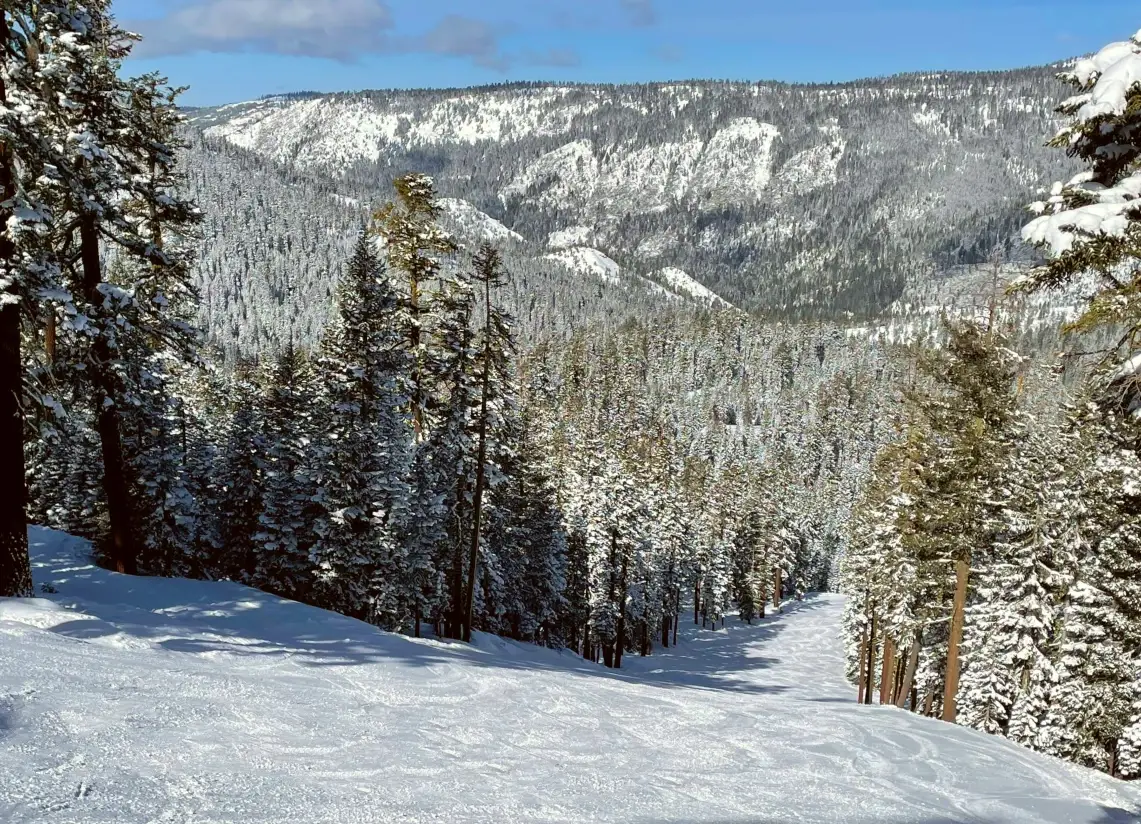
Sierra-at-Tahoe Turns 80: A Mountain Recovering From the Caldor Fire
Twenty miles or so south of Lake Tahoe, along Highway 50 near Twin Bridges, another Sierra ski resort is celebrating a much longer history.
Sierra-at-Tahoe opened in 1946 as Sierra Ski Ranch. Eighty years later, it remains one of the region’s most recognizable ski destinations, particularly among families and skiers who love its tree-lined terrain.
The resort has planned a winter of anniversary celebrations, including historical photographs, throwback events, commemorative merchandise, and a look back at eight decades of mountain history.
But for me, the most meaningful part of Sierra-at-Tahoe’s anniversary isn’t what’s happening in the lodge.
It’s what’s happening out on the mountain.
Remembering the Forest Before the Fire
I remember driving Highway 50 toward Sierra-at-Tahoe before the Caldor Fire.
I’ve never actually skied Sierra-at-Tahoe, although I’ve followed plenty of well-known skiers over the years who absolutely love this mountain.
For me, it was the landscape that always stood out.
The beautiful old forest, the towering pines, the granite slopes, and those views along the Highway 50 corridor were the kind that made you want to pull over and just admire the Sierra.
There was something special about that stretch of mountain highway.
When I returned after the Caldor Fire, it was heartbreaking.
Anyone who has spent enough time exploring the Sierra knows that feeling. You drive through a place you’ve loved for years, and suddenly the forest you remember is gone.
The Caldor Fire of 2021 burned across more than 220,000 acres of the Sierra Nevada, including much of Sierra-at-Tahoe’s property. Nearly 80 percent of the resort was affected.
The fire changed the mountain dramatically.
Sierra-at-Tahoe had built much of its reputation around tree skiing, particularly the glades and forested terrain surrounding areas like West Bowl and Grandview. The loss of so many mature trees changed both the appearance of the mountain and the skiing experience.
And it changed the drive along Highway 50 for everyone who remembered what that forest once looked like.
Planting the Next Chapter of Sierra-at-Tahoe
But one thing I’ve learned from years of exploring the Sierra is that these mountains never stop changing.
Wildfires can leave enormous scars. Recovery takes time, sometimes generations. Yet new growth eventually returns, wildlife adapts, and the landscape begins another chapter.
The Sierra is a remarkably resilient mountain range.
That’s why the restoration work at Sierra-at-Tahoe is such an inspiring part of its 80th anniversary.
Working with the U.S. Forest Service and the El Dorado Resource Conservation District, the resort has undertaken a major reforestation effort, with more than 60,000 young trees planted across the mountain, including approximately 40,000 during 2026.
Rather than simply scattering seedlings across the landscape, the planting effort has focused on establishing clusters of trees that may eventually help restore some of the forest character and tree-skiing opportunities for which Sierra-at-Tahoe became famous.
Of course, those young trees won’t replace the old forest anytime soon.
Some of the towering pines that once defined this landscape took generations to reach their size. Rebuilding a forest is not the same as rebuilding a chairlift or a lodge.
But that’s part of what makes the effort meaningful.
At eighty years old, Sierra-at-Tahoe is celebrating its past while doing something tangible for the mountain’s future.
And in a landscape where wildfire will remain part of the story, that’s an accomplishment worth recognizing.
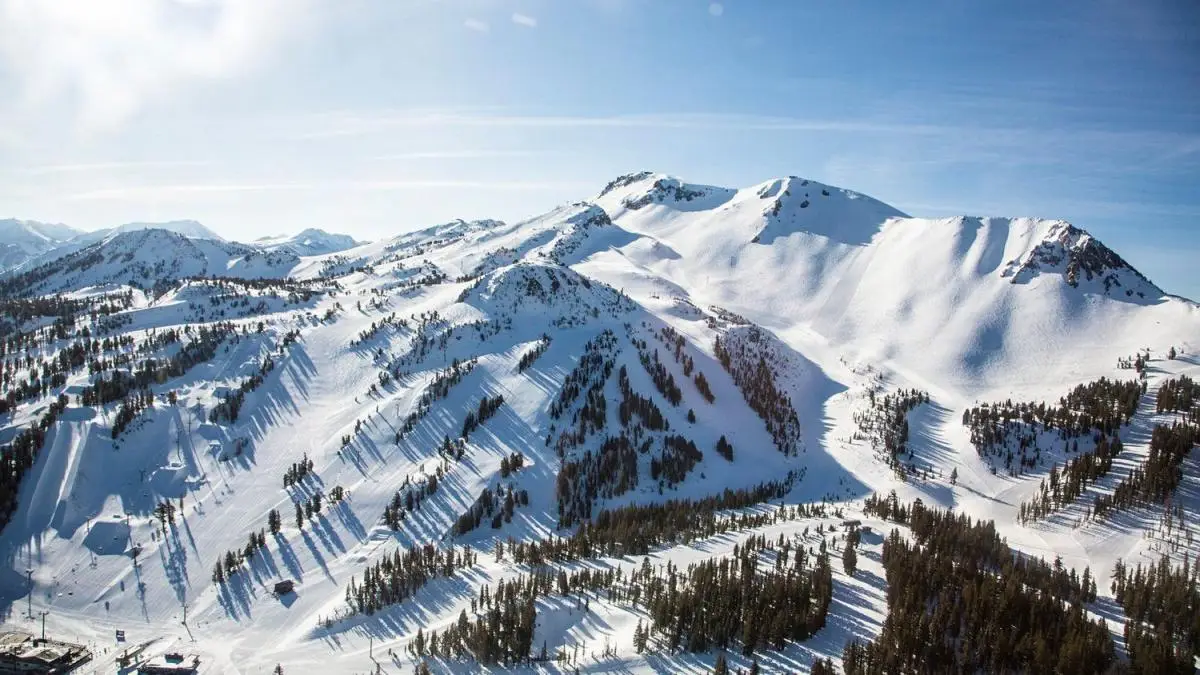
Mammoth Mountain’s Unbound Terrain Parks Celebrate 30 Years
If Diamond Peak represents the enduring appeal of a community ski hill, and Sierra-at-Tahoe tells a story of resilience, Mammoth Mountain’s anniversary is about something entirely different.
It’s about changing the sport itself.
This winter, Mammoth’s Unbound Terrain Parks celebrate thirty years of freestyle progression, creative terrain design, and a culture that helped redefine what skiing and snowboarding could look like.
Today, terrain parks are a familiar part of major ski resorts. Rails, jumps, halfpipes, and freestyle competitions are woven into the identity of winter sports.
But thirty years ago, that wasn’t necessarily the case.
Snowboarding was still fighting for acceptance at some mountains, and freestyle riding was developing a culture that didn’t always fit comfortably into traditional resort skiing.
Terrain parks gave that culture a place to grow.
From the Edges of the Mountain to the Mainstream
Mammoth became one of the mountains that helped push freestyle terrain forward.
What started as a place for riders to experiment with jumps and tricks evolved into an extensive terrain park system known for its creative design, large features, and opportunities for athletes to progress.
Today, Unbound encompasses ten terrain parks, two halfpipes, more than one hundred jib features, and over one hundred acres of freestyle terrain.
But the numbers aren’t really what make the anniversary interesting.
It’s the influence.
Terrain parks helped create an entirely different way to experience the mountain. For some riders, the goal was no longer simply getting from the top of a run to the bottom as quickly as possible.
It became about finding a line, developing a trick, expressing a little creativity, and coming back to try something again.
What was once considered a fringe part of mountain culture eventually became central to competitive skiing and snowboarding, with freestyle disciplines earning their place on the Olympic stage.
Mammoth’s Unbound program helped develop that culture and provided a place where generations of riders could push their abilities.
Thirty years later, it’s hard to imagine modern skiing and snowboarding without terrain parks.
And that’s probably the best measure of how much the sport has changed.
Another Winter, Another Way to Experience the Sierra
I’ll admit something here: I’ve never been much of a skier.
I learned when I was young, but by the time I was eighteen, after skiing at Mt. Hood, I realized that the speed and crowds weren’t really for me.
I found my own love for the mountains through hiking, backpacking, snowshoeing, and exploring places far from the lifts.
My kids grew up much the same way.
For years, winter adventures meant strapping on snowshoes, pulling sleds into the backcountry, and finding a hillside where we could spend the afternoon playing in the snow.
Then last winter, my oldest son tried skiing for the first time at Mt. Baker in Washington.
He and his wife were hooked.
He told me he couldn’t believe he’d spent eighteen years growing up in the Sierra without ever discovering how much fun skiing could be.
I had to laugh.
All those years exploring the mountains together, and here he was discovering an entirely different way to enjoy them.
I suspect someday he’ll make his way back to the Sierra with skis in hand, ready to experience those familiar mountains from a new perspective.
And maybe that’s one of the things I enjoy most about the Sierra. No matter how many years you’ve spent exploring these mountains, there’s always another way to experience them.
Sixty years at Diamond Peak. Eighty years at Sierra-at-Tahoe. Thirty years of Unbound at Mammoth.
Three very different chapters in the Sierra’s winter history, and three good reasons to celebrate another season in the mountains.

Winter 2026–27: Anniversary Events and Planning Notes
Diamond Peak — Incline Village, Lake Tahoe
The resort is celebrating its 60th anniversary with special events, retro ski days, and $60 lift-ticket promotions on selected dates. Its planned opening is in early December, subject to snow conditions.
Official information: https://www.diamondpeak.com/
Sierra-at-Tahoe — Twin Bridges, Highway 50
One honest update before you plan around it: Sierra-at-Tahoe has set its opening day — Wednesday, November 25, a retro-themed kickoff to its eightieth season after more than four feet of new snow in the past week. Grandview Express, Easy Rider Express and Nob Hill are scheduled to spin from 9 AM, conditions permitting. That beats the late-November-to-early-December window the resort was holding to, and it buries the December 26 date some trackers printed — that one never squared with anything the resort itself said. The new parking reservations, meanwhile, are real and start December 19 on weekends and holidays — free for passholders and cars with four or more people, $25 otherwise — which is its own story, and it’s in the parking piece in this issue.
New for 2026–27, parking reservations are required on designated weekends and holiday periods between December 19 and April 4, before noon. Reservations are free for qualifying passholders and vehicles with four or more occupants; otherwise, the standard reservation fee is $25.
Official information: https://sierraattahoe.com/
Mammoth Mountain — Mammoth Lakes, Eastern Sierra
Unbound Terrain Parks celebrate 30 years with anniversary activities and special park features planned throughout the winter. Park openings and available features depend on snow and operating conditions.
Official information: https://www.mammothmountain.com/on-the-mountain/unbound-terrain-parks

Sidebar: Sugar Bowl and the Gondola That Helped Shape a Mountain Village
There’s another piece of Sierra skiing history worth celebrating this winter, and it belongs to Sugar Bowl.
In 1953, Sugar Bowl introduced the West’s first ski resort gondola, connecting the Highway 40 corridor with its mountain village.
More than seventy years later, that same connection remains part of what makes Sugar Bowl distinctive.
For the 2026–27 season, the resort is replacing its previous four-passenger Village Gondola with a new eight-passenger Doppelmayr system.
The new gondola is designed to improve access to Sugar Bowl’s historic village while preserving the character of one of the Sierra’s most recognizable mountain communities.
And for anyone interested in ski history, there’s an added attraction.
Sugar Bowl plans to display historic gondola cabins from 1954, 1958, and 1983 at the Highway 40 terminal, offering visitors a look at three earlier generations of the mountain’s transportation history.
The new gondola is targeting a January 2027 opening. Until then, resort access will be through the Main Lodge.
It’s a small but fascinating reminder of just how much Sierra skiing has changed over the decades — and how some of its oldest traditions continue to shape the experience today.
Learn more: https://www.sugarbowl.com/village-gondola-update