By Charlie Pankey | Sierra Rec Magazine
Juniper Lake is one of those places in Lassen Volcanic National Park that I’ve looked at on a map more times than I can count. Tucked away in the southeastern corner of the park, it always seemed like a place worth exploring. I’d heard stories about the old-growth forest, the Boy Scout camp, the Mount Harkness fire lookout, and a beautiful mountain lake that most Lassen visitors never make it out to see.
Years ago, before the Dixie Fire, I actually tried to get there in the winter. I drove as far as I could before running into a snowbank that my truck wasn’t going to get over. It was too far to walk, so I turned around and put Juniper Lake back on my list of places I wanted to visit someday.
Then came the Dixie Fire in 2021. Much of the forest burned, the historic lookout was destroyed, and access to this part of Lassen became complicated. I hadn’t made another attempt to visit, but I never really lost interest in seeing the lake.
I’ve always been fascinated by these quieter corners of Lassen. The Butte Lake area on the northeastern side of the park has a similar attraction for me. They’re places that don’t always get the attention of Lassen Peak or Bumpass Hell, but when I look at the map, I can’t help wondering what’s out there.
In September 2026, my friend Tom and I finally made the trip to Juniper Lake. We’d spent the previous day exploring Warner Valley and decided to use our second day in the area to see whether we could reach the lake, get out on the water, and maybe find another trail worth exploring.

I wasn’t really sure what we’d find after the fire. As it turned out, Juniper Lake was every bit as beautiful as I’d hoped, even if the surrounding forest looked nothing like I’d imagined.

Getting to Juniper Lake from Chester
We were staying in the Lake Almanor area at St. Bernard Lodge, which makes Chester a convenient starting point for exploring this side of Lassen Volcanic National Park. Unlike the park’s main highway, Juniper Lake Road takes you into a remote section of the park that feels quite separate from the usual national park experience.
The drive is about 13 miles from Chester, with the final six miles on a rough dirt road. It’s not the kind of road I’d recommend for a motorhome or trailer, and you’ll want to pay attention to conditions before heading up there.
We had been looking at National Park Service information that still indicated road closures related to Dixie Fire repairs, so I wasn’t entirely certain we’d be able to reach the lake. Another reason to stay locally, Sharon at St. Bernard lodge had confirmed for us that the road was indeed open and access to the lake was available for our visit, we were able to drive all the way to the day-use area.
As we climbed toward the lake, the damage from the fire became increasingly obvious. Entire hillsides were covered with burned trees, or in some cases left completely baron, many still standing, but with little of the green forest that once covered these mountains.
I knew the fire had been extensive, but seeing it firsthand was something else. In places, it looked like a war zone, with blackened trunks stretching across the hillsides. I found myself remembering the drive and what it looked like before the fire, when the road passed through the old growth forest and you couldn’t see the surrounding hills. Or the meadows you can now see through the trees as the forest grounds recover.
Then we reached Juniper Lake, and the first thing that caught my attention was the water.

Juniper Lake: A Beautiful Place to Swim and Paddleboard
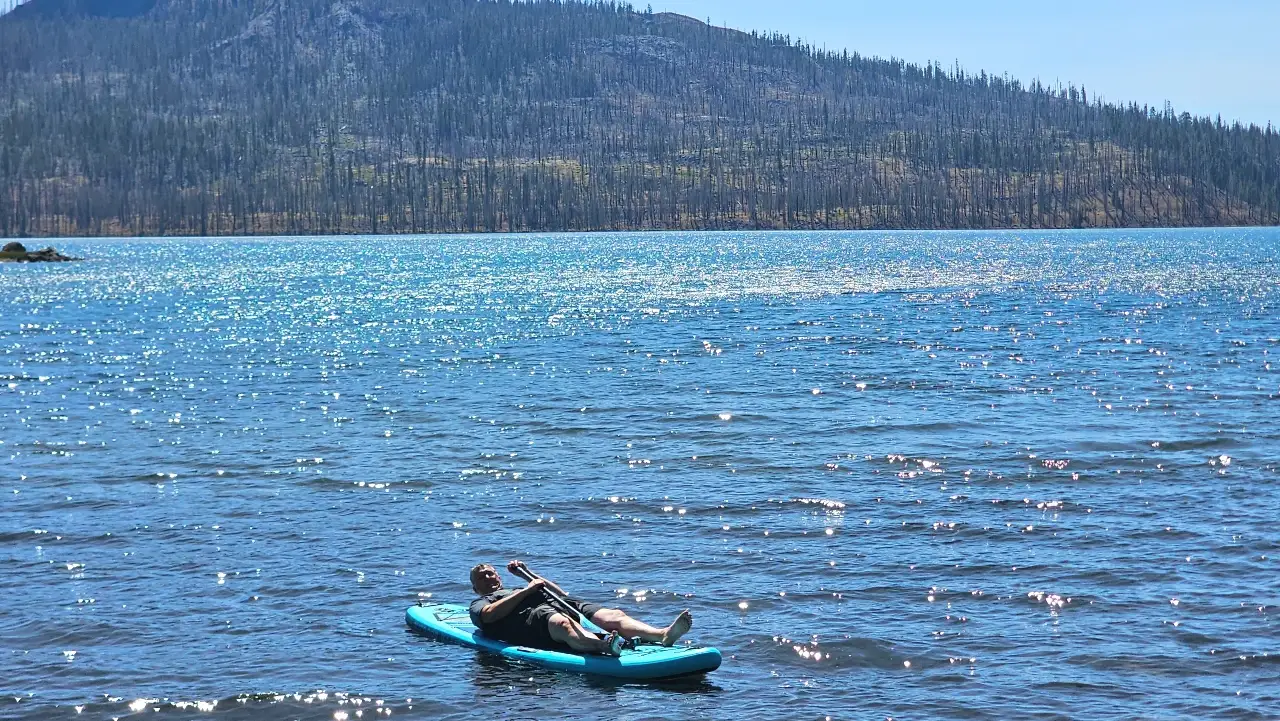
Juniper Lake is gorgeous. It’s a big body of clear blue water surrounded by a varied terrain, with a sandy beach right next to the day-use parking area. Even with the burned forest covering much of the surrounding landscape, the lake itself was spectacular.
I couldn’t help thinking about what it must have looked like before the Dixie Fire, with green trees surrounding the shoreline. There are still some surviving stands of trees near the water, and those pockets of green give you a pretty good idea of how beautiful the area must have been.
But I don’t want to give the impression that Juniper Lake isn’t worth visiting today. Quite the opposite. It’s still a really nice mountain lake, and I was surprised by how clean and inviting the shoreline and water were.
The water reminded me a little of June Lake down near Mammoth. If you’ve spent time in the Eastern Sierra, you’ll know the kind of water I’m talking about. That beautiful blue color, excellent clarity, and the feeling that you’ve found a great place to spend an afternoon.
One of the things I liked most was the beach. The shoreline slopes gradually into the lake, and during our visit you could walk what seemed like 50 or 60 yards into the water and still be around waist-deep. That makes it a great place to launch a paddleboard, especially compared with lakes where you’re immediately stepping into deep water or trying to navigate a rocky shoreline.
We had brought paddleboards with us, and the easy beach access was exactly what we’d been hoping to find. The water was also inviting enough for a swim, which felt pretty good on a warm September afternoon.
What really surprised me, though, was how few people were there.
Over the course of the entire day, we saw only two other visitors. That’s pretty unusual for a beautiful lake inside a national park, even in September.
I can imagine Juniper Lake being much busier on a summer Saturday, especially before the fire when the surrounding forest was still green. But on our visit, there was plenty of room to enjoy the beach, look around, and take our time.
We even spotted deer near the lake, which was a nice reminder that despite everything the fire changed, there’s still plenty of life in this corner of Lassen.

Exploring the Landscape After the Dixie Fire
It’s impossible to visit Juniper Lake today without noticing what the Dixie Fire did to the surrounding forest.
The fire burned through this area in 2021, destroying the Mount Harkness lookout and leaving large sections of forest severely damaged. Some of the hillsides are almost entirely covered with standing dead trees, while other areas have scattered patches of green where trees survived.
I had heard about the old-growth forest that once surrounded Juniper Lake, and that was part of what originally attracted me to the area. Seeing so much of it gone was disappointing.
But there was something interesting about exploring the lake in its current condition, too.
Without the thick forest, you can see much more of the surrounding terrain. Ridges and hillsides that might once have been hidden behind trees are now exposed, and you get a different sense of the mountains surrounding the lake.
The shoreline itself was also much cleaner than I’d expected. I had imagined more burned debris, fallen trees, and other evidence of the fire along the beach. Instead, we found clear water, a sandy shoreline, and a surprisingly comfortable place to spend the afternoon.
That doesn’t mean the fire damage should be overlooked. There are still hazards in burned areas, especially around standing dead trees, and recovery is going to take a long time.
But after years of wanting to visit Juniper Lake, I was glad we’d finally made it. The forest had changed, but the lake was still worth the trip.

Hiking to Crystal Lake: An Unplanned Adventure
Of course, no trip with me is complete without finding a trail that wasn’t necessarily part of the original plan.
That’s pretty much how we ended up hiking to Crystal Lake.
We’d come to Juniper Lake primarily to enjoy the water, but while looking around the area, we found the trail and decided to see where it went. That’s a pretty typical Charlie expedition. Find a trailhead, wonder what’s up there, and start walking.
The hike climbs away from Juniper Lake through more of the forest burned by the Dixie Fire. On a warm September afternoon, we quickly discovered that hiking through a burned forest is a different experience from walking beneath a healthy canopy of trees.
There wasn’t much shade.
The standing trunks cast these long, skinny shadows across the trail, but without branches and needles, they weren’t doing much to keep us cool. It was hot, and we were getting a pretty good dose of sunshine as we climbed.
One of the interesting things about the hike was watching a hawk hunting along the ridge above us. With so much of the forest gone, we had a clear view as it circled and worked its way across the open hillside.
I enjoy those kinds of moments on a trail. You head out thinking you’re going to see a lake, and along the way you find yourself stopping to watch a hawk.
Eventually, we reached Crystal Lake, and I immediately started thinking about how nice it would be to spend an entire afternoon there.
Crystal Lake is a beautiful little mountain lake, tucked into the hills above Juniper Lake. It’s not nearly as large, and it has a different feel from the broad shoreline and beach we’d just left behind.
This was the kind of place where I’d happily hang a hammock, bring a book, and spend a few hours doing absolutely nothing. I could also imagine what a great place it would be for a backpacking trip, assuming the location and current regulations allowed it.
The lake was quiet, and the surrounding scenery made it feel a little more tucked away than Juniper Lake.
I kept thinking about what this trail might be like on a busy summer weekend. Down at Juniper Lake, families might be swimming, paddling, and enjoying the beach. Meanwhile, just up the trail, Crystal Lake could be the place where you find a little more solitude.
We also noticed that the stream or cascade flowing away from Crystal Lake was dry during our September visit. I’d be curious to return earlier in the season to see what the area looks like when there’s more water moving through the mountains.
That’s one of the things I enjoy about exploring places like this. One visit usually leaves me with several reasons to come back.
Note for visitors: This is Crystal Lake in Lassen Volcanic National Park, not the Crystal Lake near Mount Hough in Plumas County.
Mount Harkness and Other Trails Worth Exploring
Another attraction that originally drew me toward Juniper Lake was Mount Harkness and its historic fire lookout.
The lookout stood on the summit for decades and was known for its views across Lassen and the surrounding mountains. Unfortunately, it was destroyed during the Dixie Fire in August 2021.
The mountain is still there, of course, and the trail to the summit remains part of the Juniper Lake area’s hiking network, although access and trail conditions need to be checked before visiting.
We didn’t hike Mount Harkness on this trip, but it’s still something I’d like to explore on a return visit. Even without the lookout, I imagine the views from the summit would be worth the climb.
There are also trails connecting Juniper Lake with other lakes and destinations in this part of Lassen. It’s an area that deserves more time than we gave it, particularly for hikers who enjoy getting away from the park’s busiest trailheads.
One thing I’d emphasize for anyone hiking here is the amount of sun exposure. With so much of the forest burned, some trails that once offered shade are now quite exposed. Bring extra water, sunscreen, and a hat, and pay attention to the possibility of falling trees in the burned areas.
Planning a Visit to Juniper Lake Lassen
If you’re considering a trip to Juniper Lake, I’d start by checking current road conditions with Lassen Volcanic National Park.
The road isn’t maintained for winter travel, and snow can keep it inaccessible well into the warmer months. There have also been closures and repairs related to the Dixie Fire, so don’t assume the road will be open simply because the weather is good.
During our September 2026 visit, we were able to drive to the lake, but the National Park Service’s posted trail information has continued to list road restrictions. That’s a good reason to confirm access directly with the park before making the trip.
A few other things are worth knowing:
- Getting there: From Chester, follow Juniper Lake Road toward the