A Trail-Tested Story from the Emigrant Wilderness
There’s a version of the Sierra most people never see.
It’s not the polished version—the one we photograph at sunrise or chase across trail maps and bucket lists. It’s older than that. Harder. Quieter.
And if you’re not paying attention, you’ll walk right past it.
We were standing at Aspen Meadows Pack Station, sorting out plans for a few days deep in the Emigrant Wilderness. The kind of trip where you trust the packers, follow their suggestions, and let the country unfold as it will.
That’s when Yellowhammer came up.
Not from a map. Not from a guidebook.
From a kid.
A young cowboy—already more at home in that environment than most of us ever will be—started talking about Yellowhammer Lake and Hyatt Lake like they were just part of his backyard.
Then he said something that stopped me cold:
“My great-grandfather built the cabin out there.”
That’s when Yellowhammer stopped being just another lake.
It became a story.
At first, I thought he was talking about some old forgotten shelter tucked in the trees. But the Aspen Meadows crew explained that they still occasionally bring guests back there by horse pack. The old cabin and horse camp still stand near the lake—not really functional anymore, but enough remains to form the heart of camp.

That alone fascinated me.
Deep in what most of us now consider untouched wilderness, there was once a working camp with real purpose and history.
And somehow, part of it still survived.
We didn’t head there immediately.
Day two became the push into Yellowhammer.
It was a hard day of travel through the Emigrant Wilderness—the kind of country that slowly strips away the noise of modern life. Granite ridges, quiet forests, hidden meadows, and long stretches where it feels like you could walk for hours without seeing another person.
Then the landscape opened.
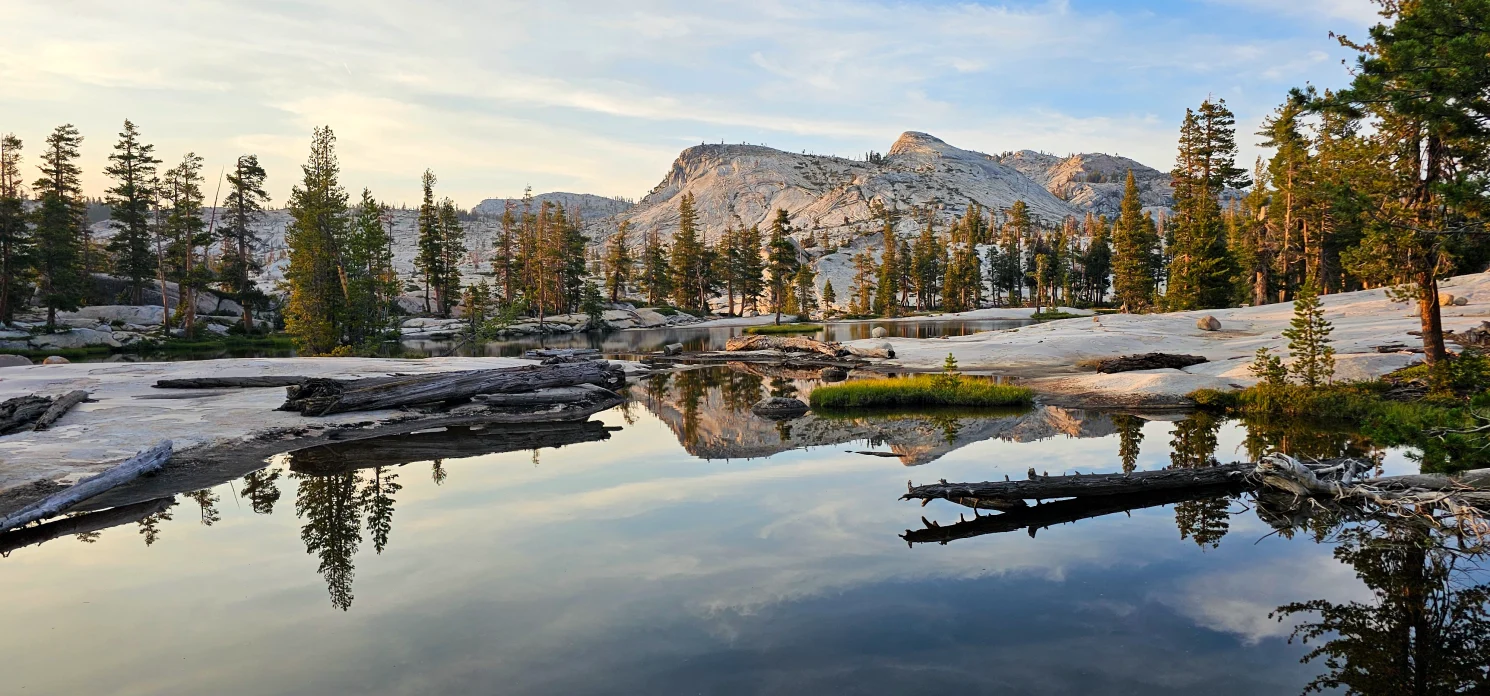
At the north end of the lake sat a stunning mountain meadow framed by trees and granite.
And hidden near the edge of it—
The cabin.

Weathered wood. Fading remains. Pieces of horse infrastructure still standing nearby. Enough left to immediately tell you this wasn’t just a random structure someone threw together for adventure.
This place had been lived in.
Nearby, pack station guests had set up camp, their gear and horses spread around the old site like a continuation of the same tradition that had existed there generations earlier.
And honestly, it felt surreal.
We explored for a while before continuing to the south side of the lake to make our own camp for the night.
That evening, Yellowhammer became one of those Sierra moments I’ll never forget.
The lake was quiet. Wild. Remote in every direction.
And yet less than a mile away, hidden in the trees, stood an old cabin and active horse camp where people were floating in tubes, fishing from shore, laughing around camp, and living a completely different version of wilderness than the one most backpackers experience today.
We laughed about the contrast that night.
How could a place feel so untouched and so lived in at the same time?
The next morning made the feeling even stronger.
As we packed up and continued exploring, we crossed paths with the mule train heading out.
The transformation from the night before was incredible.
The evening prior:
cowgirls floating in the lake,
bikinis,
fishing poles,
summer laughter drifting through camp.
Now:
denim pants,
long sleeves,
cowboy hats pulled low,
horses loaded and moving steadily through Sierra granite.
Same people.
Completely different rhythm.
And standing there watching them disappear into the trees, it suddenly hit me:
This version of the Sierra never completely disappeared.
It just became harder to notice.
Places like Yellowhammer remind us that the Sierra Nevada wasn’t always recreation.
Before wilderness permits, before trail apps and bucket-list backpacking routes, these mountains were worked. Families, cattlemen, sheepherders, miners, and horse packers moved through this country because it offered something essential—water, grazing, survival, opportunity.
Fred Leighton first entered this basin in 1895 tending cattle with his uncle, Alvah Shaw. By the early 1920s, he had started building small check dams throughout the Emigrant to slow and hold water later into the dry season. In total, 18 dams were eventually constructed across the region in places many hikers still pass through today without realizing the history beneath their boots.
The goal wasn’t tourism.
It was survival and sustainability in a harsh landscape.
Water meant life.
Still does.
That’s what makes Yellowhammer feel different from so many Sierra lakes.
It’s not just beautiful.
It holds memory.
You can still feel the overlap between the Sierra we romanticize today and the one earlier generations depended on to survive.
Most of us arrive in these places looking for escape.
But standing at Yellowhammer, it becomes impossible not to think about the people who once woke up there for entirely different reasons.
Not for adventure.
Not for solitude.
But because this was life.
And honestly, I think that’s the soul of what we miss if we don’t slow down enough to understand the places we travel through.
The Sierra wasn’t always untouched wilderness.
It became wilderness.
And scattered across hidden meadows and forgotten basins like Yellowhammer are reminders that these mountains were once shaped by work, endurance, ingenuity, and the simple determination to make another sunrise.
I’ll go back to Yellowhammer someday.
No question.
But next time, I’d love to do it differently.
Take the horse pack in. Stay near the old meadow and camp. Explore deeper toward Cherry Creek and the remote southern edges near Yosemite. Spend more time sitting quietly beside that cabin wondering what it must have felt like to build a life so far from everything.
Because Yellowhammer isn’t just another destination in the Emigrant Wilderness.
It’s one of those rare Sierra places where the past still quietly rides beside the present.