You don’t have to ski to enjoy winter in the Sierra. Around Lake Tahoe and Alpine County, snowshoeing offers another way to experience the mountains: following a creek through snowy forest, exploring an open meadow, or spending a few hours outside with family and friends.
During my years living in Carson Valley, these outings became part of our winter routine. Hope Valley was often my first choice, but we also explored the Highway 88 corridor, Silver Creek below Ebbetts Pass, and forest trails around Lake Tahoe. Each offered a different reason to strap on snowshoes and head out.
In this Sierra Rec Now conversation, I share favorite places from those years of exploring, along with ideas for families and visitors looking for winter activities beyond the ski resorts. Originally recorded during the Christmas season, the discussion offers inspiration for snowshoe outings throughout the winter, whenever snow coverage, access, and conditions allow.

Hope Valley: My Go-To Place for Winter Exploration
If I were back in Carson Valley with a winter day ahead of me, there’s a good chance I’d put the snowshoes in the car and head toward Hope Valley.
Along Highway 88, the combination of meadows, forest, and mountain scenery gave us plenty of reasons to return. Some mornings I’d head out with my buddy Tom; other days, I’d bring the kids. We liked arriving early, breaking trail, and watching familiar places take on a different character beneath fresh snow.

“Hope Valley was kind of my go-to place.”
In the podcast, I describe exploring around the Highway 88 and 89 junction, the tree line below Scotts Lake, and the Blue Lakes winter recreation area. These were places where we could shape the outing around the day—sometimes a longer snowshoe walk, sometimes a shorter family adventure with time to play.
For visitors exploring Alpine County, Hope Valley is a useful place to begin learning about the region’s winter recreation options. Choose your route carefully: open meadows and nearby mountain slopes offer very different terrain, and snow coverage alone does not tell you whether an outing is suitable.

Red Lake, Kirkwood, and Silver Lake Along Highway 88
The Highway 88 corridor offers several other places that feature in my winter memories.
Around Red Lake, I enjoyed the opportunity for more exercise and a stronger sense of venturing into the mountains. Kirkwood was one of the first places I tried snowshoeing and cross-country skiing, while Silver Lake became another starting point for exploring winter scenery farther west.
These locations belong to the same broad travel corridor, but they offer different experiences. An outing on an established winter recreation route is a different undertaking from exploring ridges or traveling into untracked terrain.
For a closer look at one part of the corridor, read our guide to snowshoeing near Kirkwood.

Silver Creek: Snowshoeing Below Ebbetts Pass
On Highway 4 beyond Markleeville, Silver Creek became another place I returned to for winter exploration.
The winter closure area near historic Silver City provides a starting point for outings along the snow-covered highway and nearby creek corridor. On my visits, I enjoyed walking uphill before exploring the forest beside the water, with snow-covered creek banks and the landscape toward Noble Canyon drawing me farther along.
The creek is a large part of the appeal. Moving water, snowy forest, and the waterfall beside Highway 4 give this outing a different character from the open meadows of Hope Valley.
Read my Silver City to Noble Canyon snowshoe story for more about the area and my experiences there.

Tahoe Meadows: A Favorite for Early Morning Outings
Tahoe Meadows near Mount Rose Highway holds some of my favorite memories of snowshoeing with family and friends.
My preference was to arrive early and spend time exploring the forest before the busiest part of the day. In the recording, I describe outings through the trees toward Inspiration Point, enjoying the birdlife and the chance to break our own trail.
“Usually I’ll take a group of kids out there or a couple of families and just have a ball for half a day.”
Timing made a difference to my experience. By the time we returned, the meadow and parking areas could be much busier. That early start gave us more of the quiet forest time I was looking for.
For visitors staying around Lake Tahoe, this is one of the places discussed in the podcast to consider when researching a winter outing.
Spooner Lake and Sugar Pine Point: Two More Tahoe Favorites
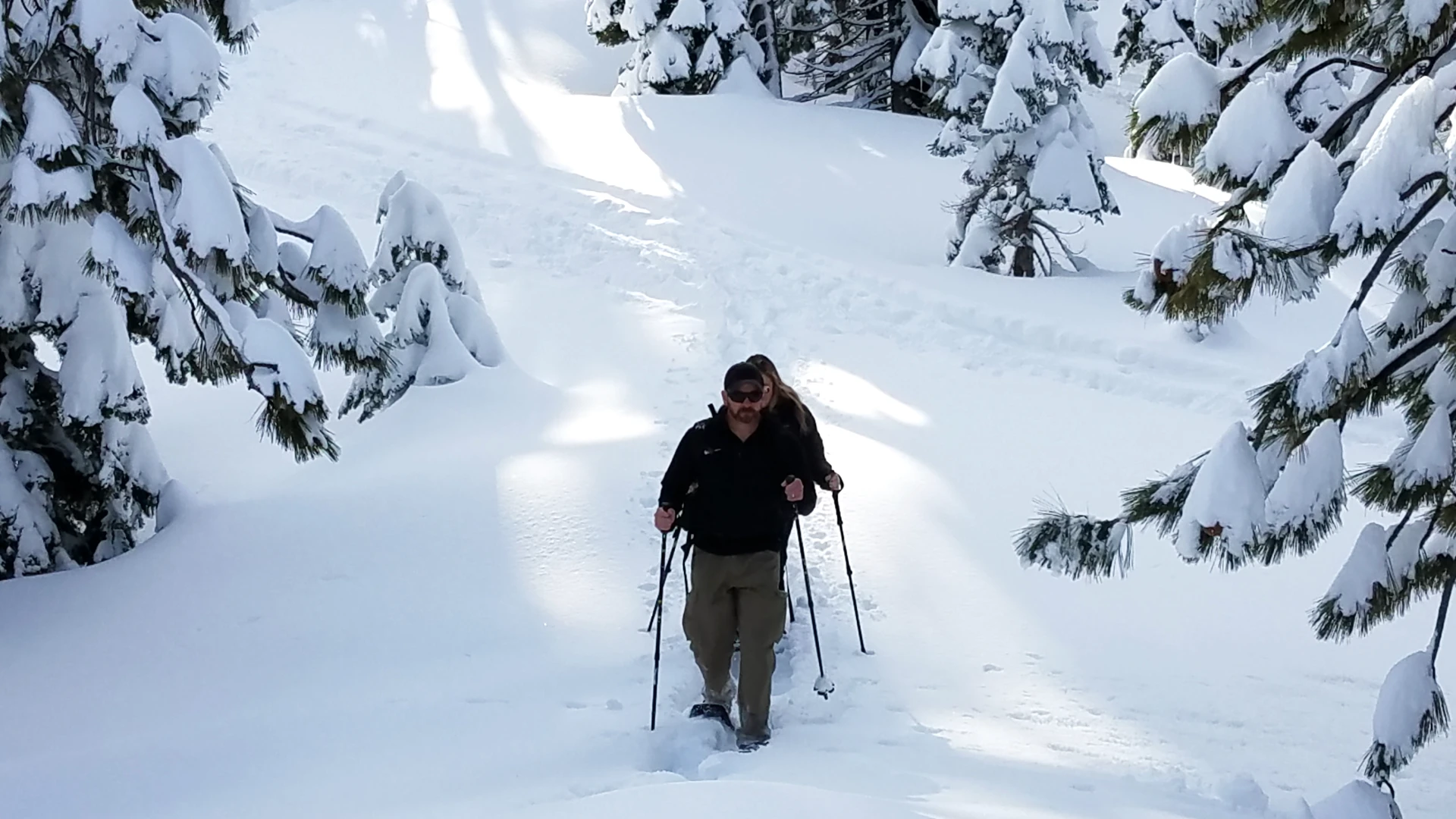
Spooner Lake was another place where I enjoyed combining a familiar destination with time exploring through the trees. In the podcast, I recall outings around the lake and toward the cabins, with the forest exploration often becoming as memorable as the lake itself.
On Tahoe’s west shore, Ed Z’berg Sugar Pine Point State Park offers another setting for snowshoeing and cross-country skiing. My memories center on the campground side of the highway, forest routes, and the scenery along General Creek.
The park also connects winter recreation with Tahoe’s Olympic history: the area hosted Nordic events during the 1960 Winter Olympics.
Explore our Sugar Pine Point snowshoeing story for a closer look at this west shore destination.
Beyond Tahoe: Lundy Canyon and Other Sierra Winter Memories
The conversation also reaches beyond Tahoe to Lundy Canyon in the Eastern Sierra, Loon Lake on the western side of the range, and the Lakes Basin near Graeagle.

My Lundy Canyon snowshoe outing took place in late winter. Having first fallen in love with the canyon during autumn, I appreciated seeing the landscape in another season. Its snowy terrain also calls for careful consideration of avalanche exposure, water hazards, and winter access.
Near Graeagle, my memories include exploring snowy roads and lakes country—and returning across my own route to discover that a mountain lion had crossed it while I was away.
These are personal recollections rather than complete winter route guides. They offer starting points for further research, with each destination requiring its own planning.
Watch: Favorite Sierra Snowshoeing Places with Charlie Pankey
Watch the full Sierra Rec Now conversation on YouTube.
The recording includes the original holiday greeting and discussion of weather at the time. Use it for destination inspiration and firsthand stories rather than current snow or road reports.
Planning Your Snowshoe Outing
Before choosing a destination, check current weather, road access, parking rules, and any required permits. Our California SNO-PARK guide is a starting point for understanding designated winter parking areas.
Match the outing to your group’s experience, navigation skills, and the day’s conditions. Carry winter layers, food, water, and navigation tools, and leave your plans with someone before heading out. Creek crossings, frozen lakes, and avalanche terrain require particular care; another person’s tracks do not establish that a route is safe.
You can find more destination stories through our Sierra snowshoeing guide.
Finding Your Own Reason to Return
What I remember most about these outings isn’t always the distance we covered. It’s the mornings with friends, the kids playing in the snow, the sound of a creek, and the feeling of being among the trees in winter.
Snowshoeing gave us a reason to keep exploring places we already knew—and to see them differently with each visit. That’s the invitation behind this conversation: find an outing that fits your experience and conditions, make time for the mountains, and enjoy being outside.