
An introductory note to the reader:
In a previous issue of Sierra REC published last year, I wrote an article entitled: Desolation Wilderness Lake Name Origins. At the conclusion of the article, I said I would write a follow-up article in a future issue about the naming of Lake Aloha. Here it is:
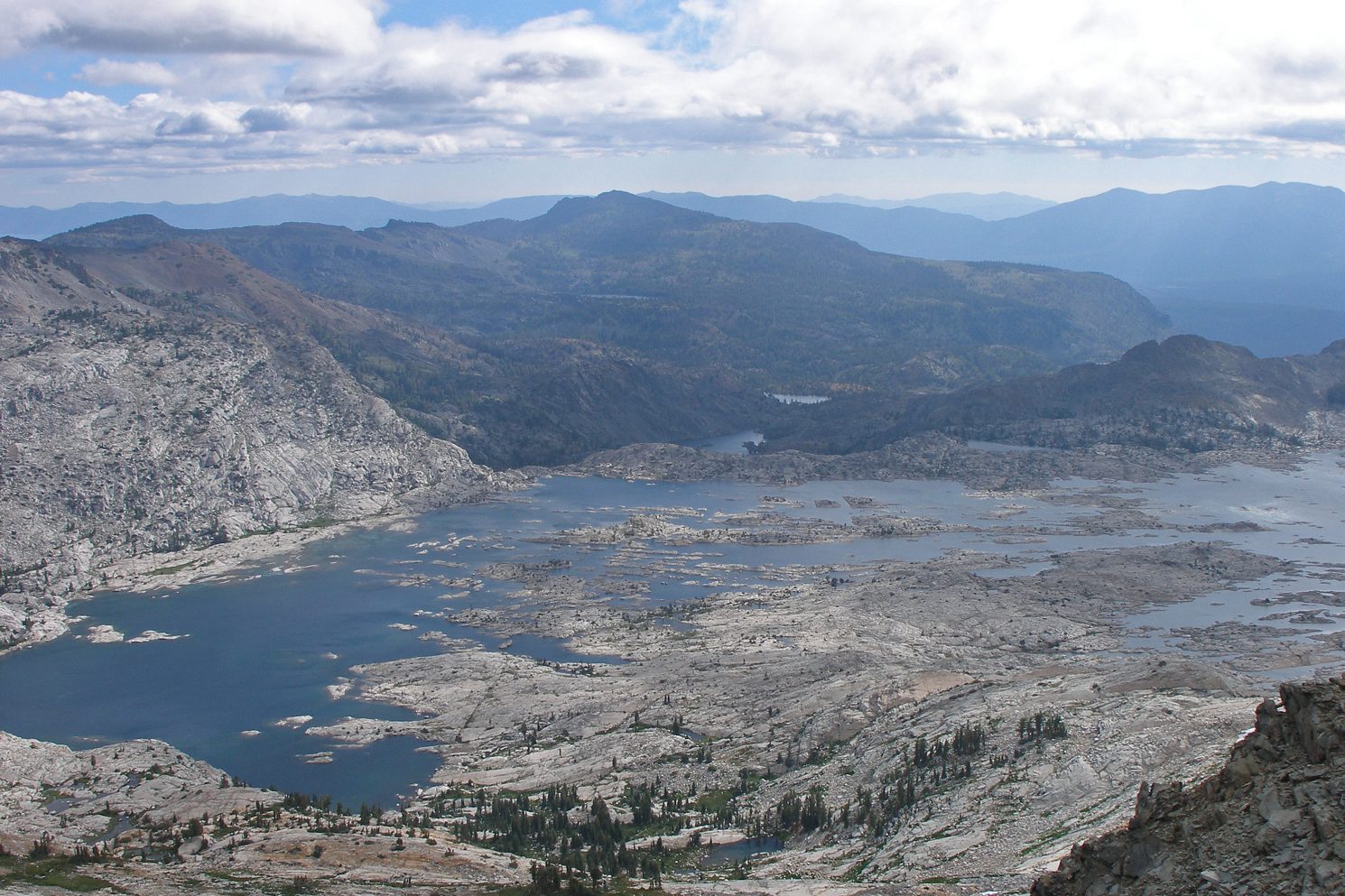
Considering the way most lakes were named in Desolation Wilderness, e.g., people’s names, things, geography, flora, etc., the name Lake Aloha is altogether norm breaking. Most people are aware that “Aloha” is a Hawaiian word meaning “hello” and “goodbye.” But it also conveys a deeper cultural and spiritual implication of love, peace, family, home, and much more. How it came to be that the largest body of water in Desolation Wilderness has this incongruous name is an interesting and somewhat involved story because the naming of Lake Aloha is part of the larger history of the Lake Tahoe region.
The Earliest History of the Basin
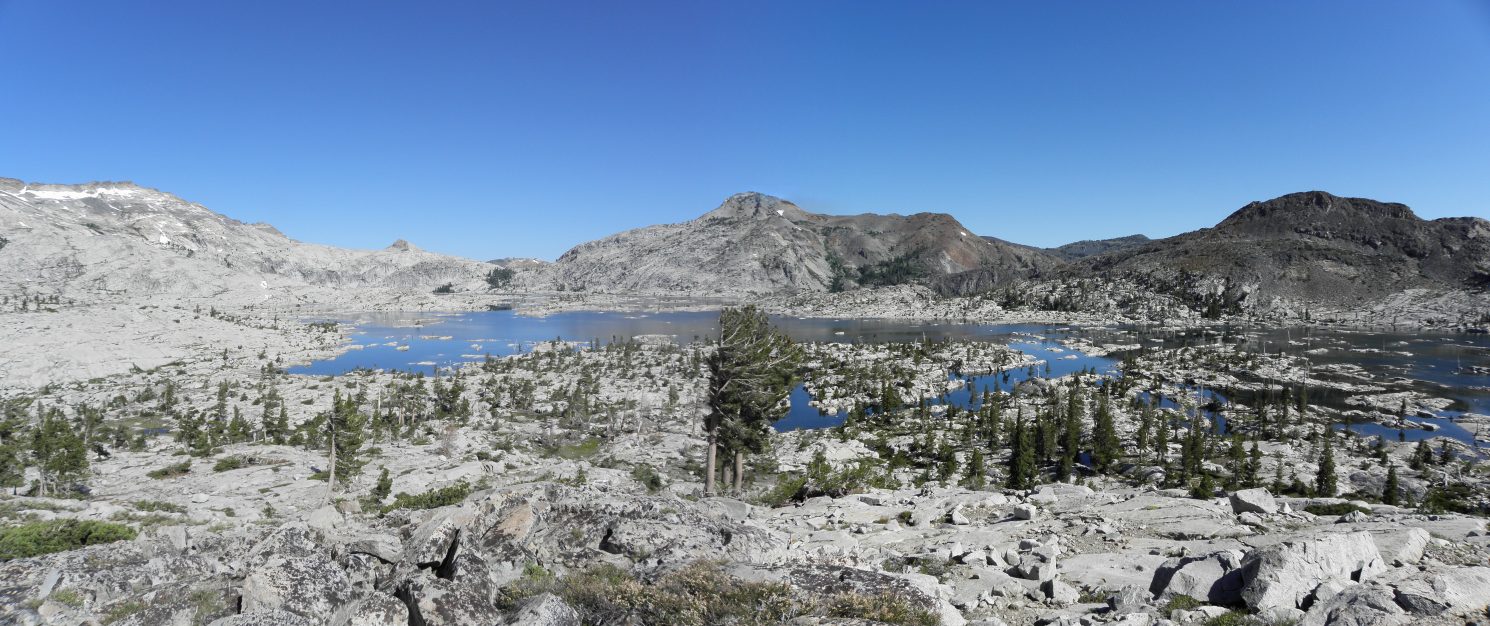
Our story begins at a large glacial granite basin located at 8,200 feet above sea level in the Desolation Valley region of Desolation Wilderness. The lake is the headwaters for Pyramid Creek that flows to the South Fork of the American River.
The end of the last glacial period in the Sierras was about ten thousand years when the area once again became visible to the world. As the last glacier retreated, remnants melted and drained away, a vast basin was revealed containing an abundance of tiny lakes, ponds, and a multitude of small granite islands. For those of us who know the wilderness of today, little has changed in the physical contours of the granite mountains and the basin in which today’s Lake Aloha resides. Of course, visual changes have taken place. What was once a lifeless piece of barren geography, the passage of time has seen the introduction of nature: flora, fauna, — and people.
Somewhere during the time period of three thousand to five thousand years ago, Native Americans arrived, lived, and prospered in the greater Lake Tahoe region. (A few sources theorize that Indigenous people were here as early as 8 to 10 thousand years ago)
There is good reason to believe that the first visitors were the Washoe people coming up from the Carson Valley in the summers as they made their way over the mountains to Wright’s Lake on the west side. Most probably, they entered the Desolation Valley area while exploring potential trails to the west side of the Sierra. However, there is no hard evidence to substantiate this.

Early EuroAmerican History
It is only within the past two hundred years that the story of the naming of that ancient body of water that became Lake Aloha begins. It is the story – the history – of the arrival of and the activities of European Americans in the region.
They began to make their way into and over the Sierras as early as 1826. First came the explorers and then settlers, most of whom were making their way over the Sierras headed for the Sacramento Valley and the coast. (Note: Lake Tahoe itself was not discovered until 1844 by John Fremont.)
A significant population influx came with the California Gold Rush of 1848 – 1855. During this period, gold seekers explored the granite mountains of the Desolation Valley area but found only a few low-grade ore deposits judged not worth pursuing and they were abandoned. (Thus, saving the area from exploitation and destruction.)
It is worth mentioning that the people who did come across the future Aloha basin were not impressed with what they saw. Writings from this period described their impressions of the glacial basin as being inhospitable, desolate, and uninviting. “Devil’s Valley” and “Devil’s Basin” were the earliest names, that we are aware of, being assigned to the basin and its collection of tiny lakes and pools. These two names would be continued in various documents and on public records into the late 1800s.
By 1855 the “rush” cooled off. The streams had nearly been picked clean and only the big gold mining companies, some of whom tunneled underground and a few other surface mining enterprises, continued to prosper. Around that time, another Sierra mountain resource was judged to possess a potential for great wealth — water.
The next wave of fortune seekers came in the form of farsighted businessmen. They envisioned a future where California’s growing populations in the towns and cities to the west of the Sierras would require more and more water. They realized that the control of the water resources in the mountains and its distribution to those who would pay for it was an opportunity they could not ignore.
In the middle of the 1860s, groups of businessmen set about forming companies to investigate the feasibility of obtaining control of the water in the mountains which would lead to building water storage and distribution systems that would provide water year around to future customers. They sent out Survey Crews to explore the mountains in search of such opportunities.
The leasing of Water Rights quickly became “the new game in town.” Leases would include the rights to the water in creeks, streams, and lakes as well as land for the transport of the water via ditches, canals, and flumes — plus land that, foreseeably, could be dammed.
Eventually, survey crews followed the Pyramid Creek to its headwaters in the Devil’s Basin (the eventual home to Lake Aloha). The surveys made in the basin confirmed the expectation that it could be dammed.

New Lake Names Come on the Scene
By this time, enough was being written about the Basin that several new lake names, the “Lake of Mazes,” the “Medley of Lakes” or just “Medley Lakes” appeared in reports and public records. The new names painted a more accurate picture of what was seen in the basin, i.e., the mini lakes, pools, and little granite islands.
The Medley Lakes Dam was constructed in 1875 with the purpose of creating a Shallow Reservoir storage area. As the new reservoir was filling, the rising water made not-so-subtle changes to the basin view by connecting many of the small ponds and pools visually creating minor lakes that continued to expand into larger bodies of open water. Countless little granite islands were also removed from view as they seemed to sink below a rising surface level of the new reservoir.
People were even becoming kinder in their descriptions of the Lake Medley basin reservoir. One writer penned, “the Devil’s Basin is rich in unusual beauty and picturesqueness … with the marvelous and alluring maze of lakes, bays, straits, channels, inlets, and blind alleys in the ever-fascinating Devil’s Valley.” — circa 1880.
As a result, a new name, “Lake Medley,” was assigned to the largest body of water now occupying the Devil’s Basin. At least two other decent sized lakes had come into being, one of which would be given a name in the future as it became a part of the bigger story of how Lake Aloha was named.
The man most responsible for the lake’s protection and its name comes to California.
Perhaps the most important piece of the lake naming story began twenty-five years before the damming of the Devil’s Basin, when a man named Nathan Gilmore came to California. He would have a major effect on the mountains just to the west of Lake Tahoe, particularly the Devil’s Valley area (now Desolation Valley) and naming the new shallow reservoir — Lake Aloha. It is a story worth imparting to the reader.
Gilmore came to California in 1850 in search of gold. Having not been successful in finding gold, he involved himself in several business ventures in the Hangtown area (Placerville) on the western slope of the Sierra Nevada. After several years of only modest successes, he sold out and moved to Lake Tahoe and settled close to Fallen Leaf Lake and began farming and ranching with cattle and angora goats. Within the ensuing years, Gilmore also spent a substantial amount of time exploring and becoming better acquainted with the vast beauty of the mountains that rose above his homestead.
I think one could safely say that he was developing an extraordinarily strong affinity for the land – the wilderness. He and his friends established many trails in the mountains surrounding his homestead and to the Devil’s Basin area.
As the years passed, he became more aware of the increasing number of people visiting the Lake Tahoe area to vacation and enjoy the mountains and lakes. He thought that if he provided “comfortable” accommodations people would come. He was right. They did.
His resort idea grew into the first family resort in the Lake Tahoe area. As his resort became more successful in the 1860s, he changed his vocation from farmer/rancher to resort operator. He named his resort the “Gilmore Springs Resort.” (Due to the 1863 discovery of a soda spring on his property – which is another interesting story)
The trails he and his friends had built opened the wilderness mountains to his summer guests. They thought of the Sierra mountains to be very much like the majestic mountains of Switzerland of which some were familiar. Gilmore often hiked with his guests and imparted to them his affection for the mountains. I can surmise that his efforts were akin to the conservation and preservation philosophy intensifying throughout the United States around this time.
In 1871, Gilmore filed for a possessory rights homestead deed for 10,000 acres of land that extended from his resort near Fallen Leaf Lake into the heart of what was then known as Devil’s Basin (now Desolation Valley). He expanded the resort’s visitor capacity with more permanent buildings close to Fallen Leaf Lake.
The next two decades saw many new resorts being constructed along the western shore of Lake Tahoe. Entrepreneurs were appearing on the scene. One such man, Elias “Lucky” Baldwin, came to South Lake Tahoe, purchased an existing resort, and started buying up land around it which was quite near Gilmore’s homestead deeded land. Suspicions were raised that Baldwin, who was known as an aggressive and shrewd real estate speculator during the second half of the 19th century, was trying to encroach onto Gilmore’s land. The term “claim jumping” was even suggested by some writers. It was known, though, that he had his eye on the lakes to the west of Lake of the Woods. Those lakes, now known as the Chain of Lakes, would be the ones in Desolation Valley connected by Pyramid Creek flowing south by southeast from Devil’s Basin.

Seeking Protection for Gilmore’s Land Holdings
Around 1890 an effort was begun to prevent Baldwin’s expansion into the wilderness. Gilmore, along with others, began to formulate a plan by which the holdings in his land deed would be protected by the U.S. Government from attempts to take over possession by anyone entity.
In1892, Gilmore, along with John Muir the Sierra Club president, Warren Olney the Sierra Club vice-president met at Glen Alpine Springs Resort. Also in attendance were the presidents of UC Berkeley and Stanford U, plus the Governors and some legislators from California and Nevada. Together, they initiated a petition campaign that strongly encouraged the President of the United States to create a Forest Reserve to protect specified lands near Lake Tahoe.
Gilmore’s idea was that the land he first saw needed to be protected so future generations could see it as it originally was when he, Gilmore, first looked upon it.
A Forest Reserve was initially created to protect lands with some utility (something to use or consume: minerals, grazing, lumber harvesting, etc.) This would be the first time a Forest Reserve would be enacted to protect the scenic value.
As an incentive to creating the new Forest Preserve, Gilmore would agree to donate his 10,000 acres containing the spectacular examples of mountains, lakes, and streams to be a part of the new Forest Reserve. Letters and petitions to create the Forest Reserve continued being sent to the Land Office and to each of three consecutive presidents who were in office during the time span they waited for a decision. During this time, two new lake names were introduced in written articles and reports. The first, named Medley Lake, was renamed Olney Lake (also mentioned as Olney, the Lake of Mazes). The second one was called Devil’s Lake. Both names were homages: Olney most probably to honor him for his continuous legal efforts behind the scenes to help in creating the involved paperwork effort on behalf of Gilmore’s Forest Reserve application. The name Devil’s Lake was likely in recognition of the original name of the entire basin from years before.
Also, during this waiting period, Gilmore’s Forest Reserve petition campaign, which was viewed favorably, had quietly stimulated the Government to plan for the inclusion of more Sierra Nevada mountain acreage from the Lake Tahoe area to be included in the Forest Reserve plan. Gilmore’s donation of his land would be a key to achieving protection via Forest Reserve status with a President’s signature creating the mandate.
It was in 1899 that President William McKinley signed a proclamation creating the Lake Tahoe Forest Reserve, which protected 136,000 acres of choice Sierra Nevada mountain land including the 10,000 acres intentionally donated by Nathan Gilmore to protect his land for future generations.
Sadly, Nathan Gilmore passed away on 18 April 1898. Unfortunately, he did not live long enough to see his beloved Devil’s Valley be granted the protection he had sought for six long years. However, the lake and the valley he is responsible for bringing under the umbrella of Federal protection lives on in perpetuity as an important part of his legacy. History acclaims Nathan Gilmore as a true visionary whose legacy became anchored in the preservation of his mountain possessory rights homestead deed.
In 1917, the height of the Medley Lakes Dam was raised, and eleven auxiliary dams were added at low points around the basin to increase the storage capacity. As the lake level rose in the Medley Lake Basin, the two existing named lakes, Lake Olney and Devil’s Lake slowly vanished from sight as they both slipped below the rising surface level of the “new” reservoir. The larger open expanse of water opened the door for a new lake name.
A New Lake Name Arises
It just so happened, there was a name that had been around for some years but had not been seriously considered. As the story goes, in the early 1890s, there was a Hawaiian Pineapple plantation owner, F. T. Stoltz and family, who would visit Glen Alpine Springs Resort almost every summer. On their first hike to the Devil’s Basin, they were overwhelmed by what they experienced in that first moment of visual contact with the basin. It is easy to imagine that the sheer beauty of the blending of the blue color of the sunlit basin’s water with the blue sky and the sparkling granite crystals in the surrounding mountain setting was a spiritual experience for them. They knew Aloha was speaking to them. Aloha was welcoming them with an open heart. The Stoltz family then and there named the lake “Aloha” – with Nathan Gilmore’s blessing, I’m sure.
G. W. James (author of The Lake of the Sky) beautifully describes his experience that strongly supports the previous discussion:
[Climbing] “On, over the granite embankment, and lo! Your heart is stilled as your eyes behold the marvelous Desolation Valley. Greeting you on its southern boundary stands majestic Pyramid Peak and its lofty companions circling to make the walls forming the granite cradle of Olney, the Lake of Mazes. The water is as blue as the sky above. He who has not looked upon this, the most remarkable of all the wonder pictures in the Tahoe region, has missed that for which there is no substitute.”
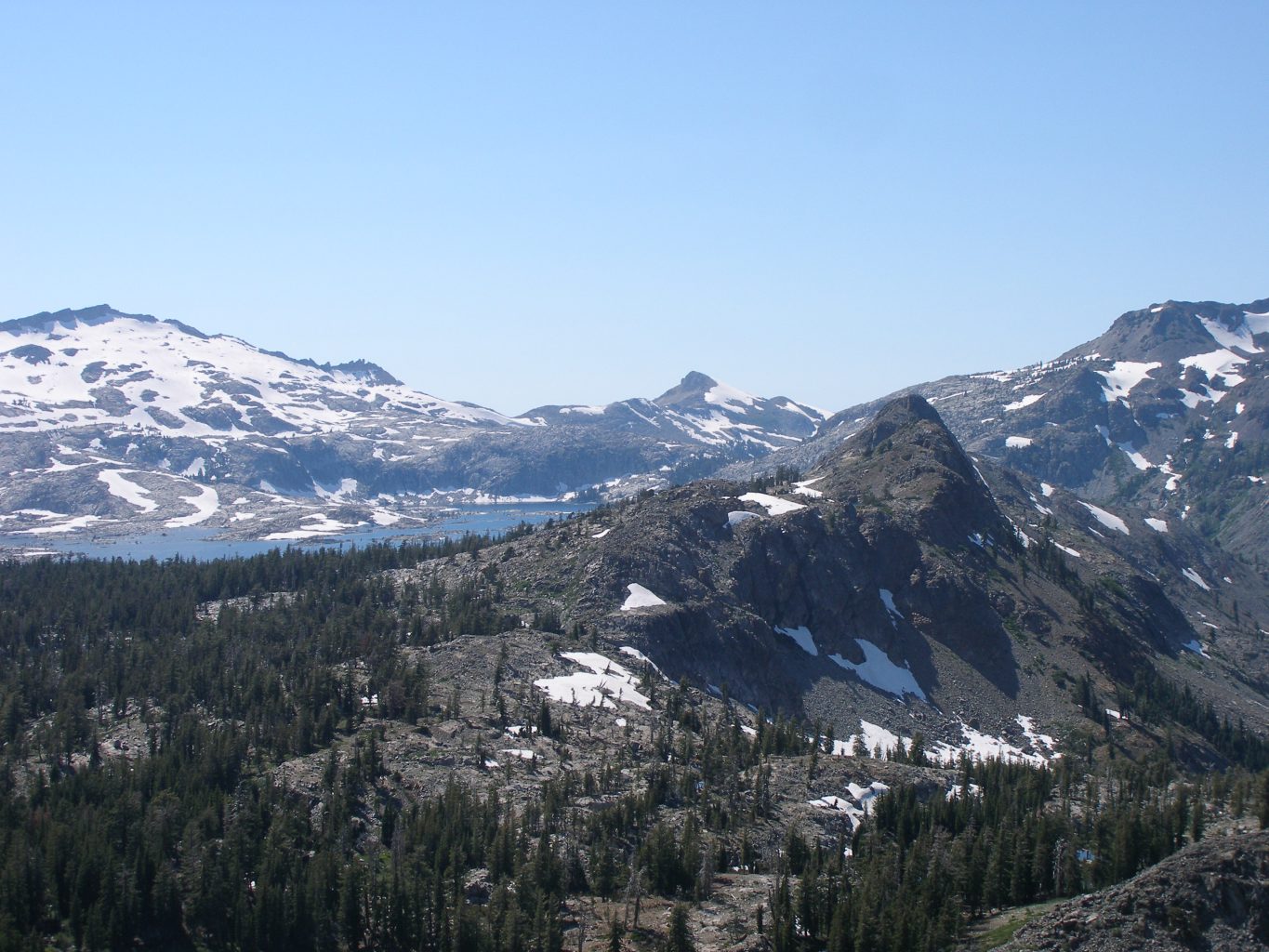
From my own firsthand experiences with “Aloha” when visiting the Islands and through my having been immersed in a multitude of personal wilderness experiences, I can attest to the harmony of the two experiences. I believe the Stoltz narrative remained with folks at the resort as a thing of beauty and was repeated often enough that it became an addition to the lore of the Glen Alpine Springs Resort.
After the dam was raised in 1917 and a new larger lake emerged, the name “Aloha” received comfortable acceptance and became acknowledged as the lake’s name. And it did so without comment or judgment in opposition that I could discover.
Since then, the name “Lake Aloha” has made its way onto maps and TOPOs used in the twentieth century, and also found in hiking books and Trail Guides. Today we seldom if ever see names other than Lake Aloha in use.
And there you have it; the story of how the very special body of crystal-clear water in Desolation Wilderness changed over time and became known as “Lake Aloha.” Go and see for yourself this marvelous basin lake and explore its environs.
Happy trails.
