By Charlie Pankey | Sierra Rec Magazine
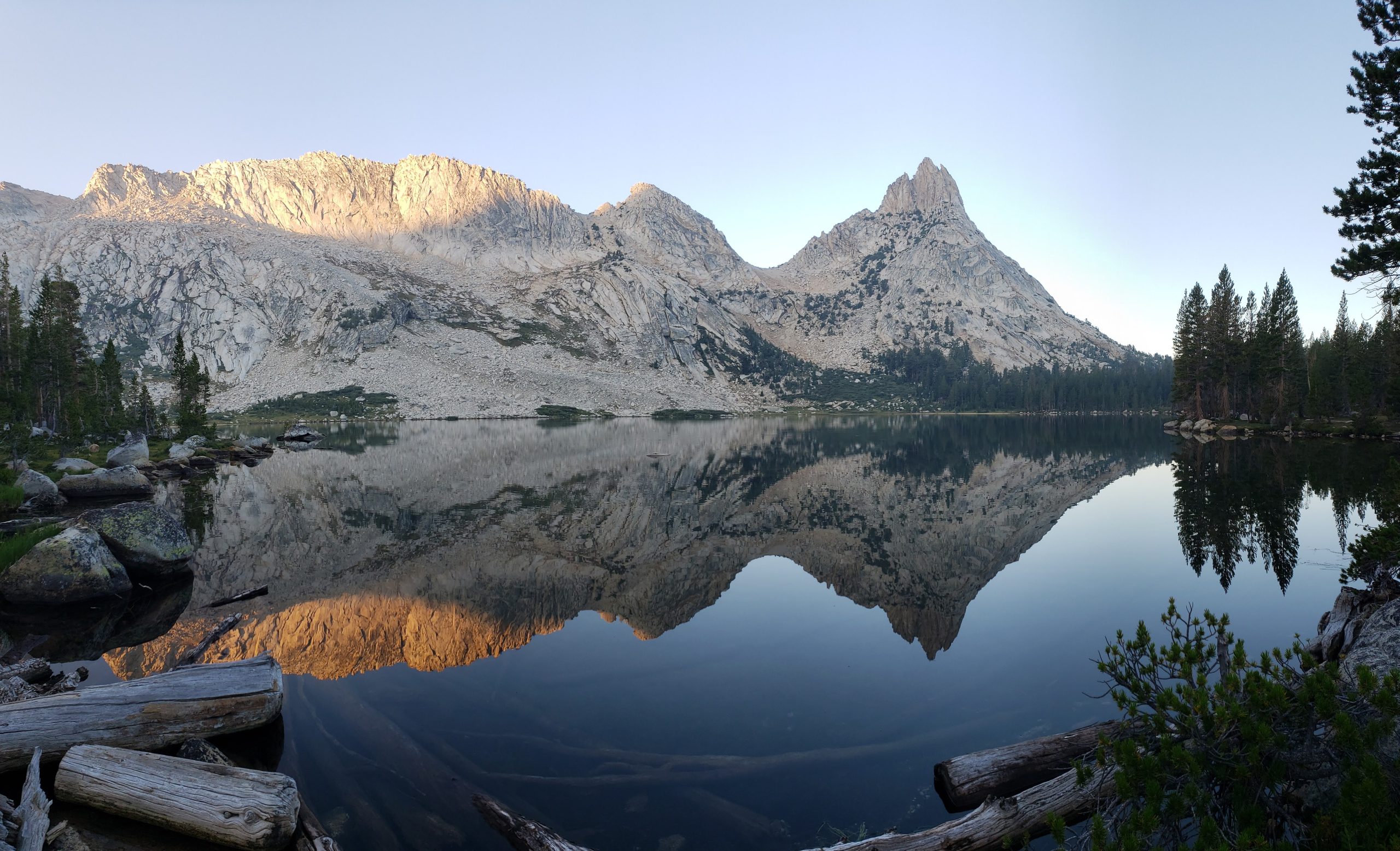
There’s a moment in the Sierra when the light doesn’t just fade — it transforms. Long after the sun dips below the horizon, a hush falls across the granite. And then it begins: that soft blush of pink, the golden-orange whisper that climbs the peaks like a final blessing of the day.
I didn’t grow up with this. Not in the Cascades, at least not that I remember. Maybe I wasn’t looking. But here in the Sierra, alpenglow found me. Or maybe I’ve just learned to sit still long enough to notice it.

Some of my favorite evenings — legs sprawled out in the dust, back propped against a warm rock after a long day’s hike — were spent waiting for that glow to hit. Snack in one hand, water in the other, silence shared with friends or the steady rhythm of my own breath. It’s a moment that doesn’t need words.
My buddy Tom, the scientist in our crew, would probably tell you about particles and backscattered wavelengths, and how the sun’s light travels a longer path through the atmosphere when it’s below the horizon. He actually gets the physics. Me? I just know when the sky goes clear blue and the peaks light up in pink, I’ve found the sweet spot.


There was that morning at Bernice Lake — the kind of glow that makes you forget about the mosquitoes and just reach for the camera, stunned. Or that time at Nelson Lake when the meadow grasses turned a shade I didn’t think grass could be. Booth Lake, where Vogelsang caught the light just above the trees. And Youngs Lake — sunset there felt like a fire painting the White Mountains in the distance.
Sometimes the glow is on the ridge I’m camped below. Other times, I’m lucky enough to be on the ridge that catches it. That changes everything.

I’ve chased these moments across Desolation, Hoover, Yosemite, Ansel Adams — and every time I think, this is the best one yet. And still, I wonder what it’ll look like this summer from McCabe Lakes. Or Matthes.
Alpenglow isn’t just a light show — it’s a ritual. A reason to rise early. A reason to stay out late. A quiet promise that even as the day ends, something beautiful is still about to begin.
SIDEBAR: Ask Tom – What Is Alpenglow, Anyway?
By Tom, the Scientist Friend Who Always Asks “Why?”
You know that glow Charlie gets all poetic about? That’s alpenglow — and yes, it’s real science, not just backpacker myth.
Here’s the simple version: Alpenglow happens just after sunset or just before sunrise when the sun is below the horizon. So technically, there’s no direct sunlight hitting the peaks. What you’re seeing is reflected and scattered light — bouncing around the atmosphere like a cosmic game of pinball.
Sunlight passes through more atmosphere during these low-light times. That filters out shorter blue and green wavelengths (they scatter more easily) and lets the longer red, orange, and pink wavelengths dominate the view.
It’s like nature’s color filter — only instead of a lens, you’ve got air molecules, dust particles, and maybe even wildfire smoke playing a role.
And here’s the kicker: true alpenglow only shows up on high-elevation terrain opposite the sun’s position, because the sunlight is bouncing off the lower atmosphere and lighting up those ridges in reverse.
Want to see it at its best?
- Look east at sunset or west at sunrise
- Find granite peaks, alpine lakes, or snowfields — they reflect the glow beautifully
- Hope for clear, dry air with minimal haze — or the right kind of smoke if you’re a photographer
So yeah — alpenglow isn’t just pretty. It’s a whole atmospheric light show, and the Sierra Nevada just happens to be one of the best theaters in the world for it.