
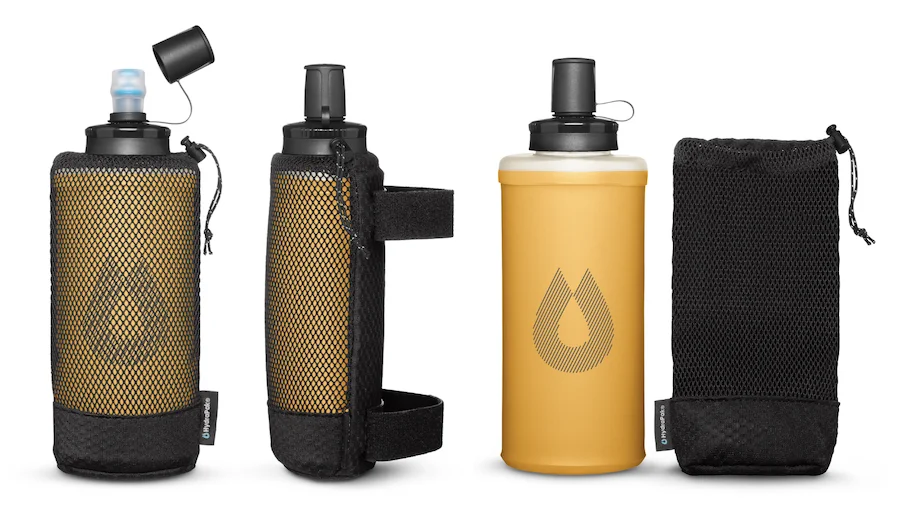
One of the best parts of summer trade events like OMA is getting your hands on next season’s gear before it hits the broader market. In July, I met the HydraPak crew and walked away with a piece that immediately made sense for the way I hike: the HydraPak PackFlask™ 500ml with its integrated filtration setup and shoulder-strap carry.

I put it to work on a backpacking trip in the Emigrant Wilderness in August, then kept it in rotation through fall on multiple day hikes, including Green Creek when the colors were peaking. After real miles, real refills, and a few pack swaps, here’s the honest breakdown.
What It Is
At its core, the PackFlask is a collapsible, soft-sided bottle that rides up front on your pack strap (or in a side pocket), paired with a filtering solution that lets you dip and drink without stopping to do the full “sit down, pull out the kit, pump, repack” routine.
HydraPak deserves credit for one key detail here: they’ve built serious trust in the filtration world. Learning they’re behind filtration technology used across the industry gave this system instant credibility for me. I’m picky about water treatment—especially in the Sierra where clarity can fool you into getting lazy.
Why I Tried It
I’d already been carrying a simple collapsible bottle on my shoulder strap. The difference with this setup was the filtering unit—that “grab water and keep moving” capability.
If your hiking style leans fast-and-light, or you just don’t want to break your rhythm every time you cross a creek, the PackFlask hits a sweet spot: it’s simple, light, and immediately useful.
Trail-Tested in the Sierra: Emigrant Wilderness + Fall Day Hikes
Emigrant Wilderness (August)
Emigrant is a perfect proving ground because water access is frequent. In many places, lakes and streams are close enough together that you don’t need to carry a massive load—if refilling is easy.
That’s where this system clicked.
- Refill speed: dip, fill, keep hiking
- Effort: minimal—no pumping fatigue, no big routine
- Consistency: I stayed hydrated because it was effortless to top off whenever I passed water
With lakes often “about a mile apart” out there, I could run this bottle as my primary and just keep it topped off all day.
Green Creek (Fall)
On fall hikes where water is still accessible but you’re moving steadily and stopping less, the shoulder-strap positioning really shines. It becomes a “quick hit” hydration option that keeps you drinking without thinking about it.
What I Loved
1) Shoulder-strap filtration changes your pace
This is the big one. Having a filtered solution accessible up front makes hydration feel like part of your stride, not a separate task. For day hikes and pack trips where water is available, this has become a standard in my kit.
2) Comfortable mouthpiece + squeeze feel
The mouthpiece is comfortable, and the soft bottle has that familiar easy squeeze feel. It drinks naturally and doesn’t feel awkward or finicky while moving.
3) Durable feel on Sierra granite
The thicker material gave me confidence. If you’ve ever shoved a bottle into a side pocket and scraped past granite, you know why that matters. I didn’t feel like I had to baby it, and I wasn’t worried about abrasion turning into a leak.
4) Versatile carry options
Even though the system is designed for front carry, the bottle also fits comfortably in a side pack pocket, which matters when you’re switching between packs or moving between day hike and backpacking setups.
What Didn’t Work as Well
The mesh pouch attachment can slide (pack-dependent)
The stretch mesh “cooling” pouch uses a Velcro-style shoulder strap attachment, and on some packs it can slide around unless you can anchor it against a loop or a feature on the harness.
That means the strap carry is not universal across every pack harness design. On packs where there’s nothing to “ground” the attachment, it can shift enough to be annoying.
This wasn’t a dealbreaker for me, because:
- it works great on certain packs, and
- the flask still rides well in a side pocket when needed
But it’s worth knowing up front: your pack harness design matters.
Capacity Reality Check: 500ml / 1 Liter Doesn’t Last Long
This system is best when you’re hiking where water is frequent. A half liter (or even a liter, if you’re using the larger bottle in the same style) goes quick—especially in warm weather or during sustained climbs.
In water-rich terrain like Emigrant, it’s perfect. In long dry stretches, it’s not the whole plan—more like the “front-access” part of your hydration strategy.
Who This Is For
You’ll love the PackFlask filter setup if you:
- hike in the Sierra on routes with regular creek/lake access
- want to move faster and stop less
- prefer a simple, lightweight hydration + filter routine
- like the idea of front-carry filtered water for quick sips
You may want to pass (or at least test fit) if:
- your pack harness has no good anchor points
- you mostly hike dry routes where refills aren’t frequent
- you want one bottle that carries your full-day water without refilling
Sierra Rec Verdict
After a backpacking trip in Emigrant and repeated fall day hikes, this is one of those pieces that quietly becomes part of your normal system.
It’s not flashy. It’s just effective.
The ability to dip, filter, and keep hiking makes hydration easier, and when hydration is easier, you do it more often—which matters more than most people admit on long Sierra days.
The pouch attachment is the only real weakness, and it’s pack-dependent. But even with that, the bottle itself earns a place in my kit because it works in multiple carry positions and feels tough enough to handle Sierra abuse.
Bottom line: For fast-and-light Sierra hiking in water-rich terrain, the PackFlask filtration setup is an easy win—and it’s now a standard part of my day hike and backpacking routine.
Quick Pros / Cons
Pros
- Fast, simple filtered refills while moving
- Comfortable mouthpiece + squeeze-drink feel
- Durable material (confidence around granite)
- Works on strap or in side pocket
- Great for water-rich Sierra routes
Cons
- Strap/pouch system can slide on some packs
- Small capacity means frequent refills (by design)